

Introduction
Reliability and quality assurance are primary goals for manufacturers across sectors, but one influential environmental factor is all too often neglected: humidity. Variations in relative humidity do more than affect comfort; they play a significant role in determining how materials age, degrade, or fail. For businesses intent on delivering robust, reliable products, investing in accurate humidity testing with a temperature humidity chamber can be the difference between market-leading performance and product recalls. When humidity is not controlled or evaluated during the product development process, companies risk latent failures and dissatisfied customers. Even the most advanced designs or durable materials can succumb to environmental stress if their limitations are not properly understood or tested. Through careful assessment and proactive measures, products can retain functionality and meet expectations in even the most demanding environments.
Even major industries like electronics, pharmaceuticals, and automotive rely on precise environmental control to protect complex products from the hidden hazards posed by water vapor. Ignoring this silent threat often leads to higher returns, warranty claims, and a weakened brand reputation.
Meticulously developed test protocols help ensure that a new device or material will actually work as promised in the field, not just in the safety of a laboratory. Ultimately, the discipline of humidity testing bridges the critical gap between innovation and consistent real-world performance.
Impact of Humidity on Materials
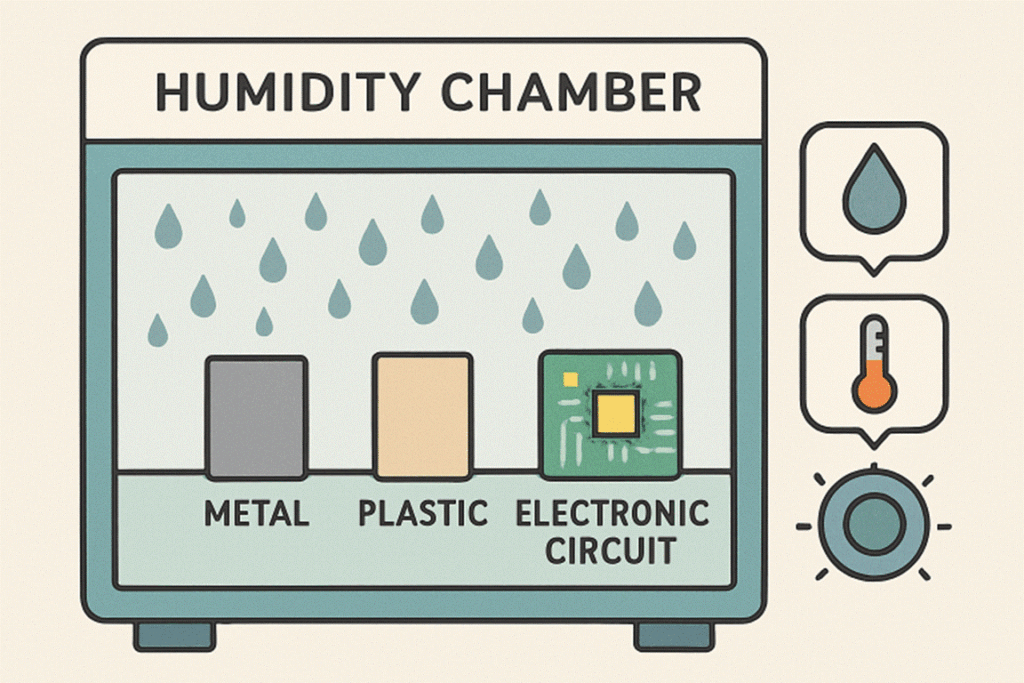
Understanding precisely how different materials respond to moisture exposure can powerfully influence design decisions. Materials do not react the same way to increased humidity; some may warp or swell, while others might rust or corrode.
- Metals: High humidity accelerates corrosion. Water molecules in the air facilitate oxidation, undermining the strength and longevity of metallic components. This is a particular challenge within the transportation and infrastructure sectors, where failure can have dangerous consequences.
- Plastics: Many types of plastics absorb water over time. This absorption can cause dimensional changes, loss of mechanical integrity, or chemical degradation, all of which undermine the safety and function of parts used in everything from packaging to automotive components.
- Electronics: Moisture interacts with the sensitive circuitry inside modern devices, often resulting in reliability concerns ranging from instant short circuits to gradual insulation breakdown. The intricate miniaturization of electronics makes them especially vulnerable to even minor increases in humidity.
These realities make the ability to simulate and measure humidity exposure during development crucial for long-term reliability and product quality.
Industries Requiring Humidity Testing
No single industry is immune to the effects of humidity, but several are especially dependent on comprehensive testing and environmental control to deliver safe, stable, and high-performing products.
- Electronics Manufacturing: Modern consumer devices and enterprise hardware are packed with sensitive microchips that are highly susceptible to condensation, corrosion, and even static discharge at unusual humidity levels. Most manufacturing environments target a strict 40–60% relative humidity range to minimize the risks of both dryness and excess moisture. For deeper insights, learn about best practices in electronics manufacturing humidity control.
- Pharmaceuticals: Both storage and production are tightly regulated to maintain drug stability. Fluctuating humidity can introduce contaminants or degrade active ingredients. The pharmaceutical sector is obligated to use validated equipment for both production and packaging, in compliance with regulatory frameworks such as Good Manufacturing Practice (GMP).
- Automotive: Vehicles are frequently subjected to rapid temperature changes and variable humidity levels, making it essential to test components for both corrosion resistance and dimensional stability to guarantee safety throughout their life cycle.
Additionally, industries such as aerospace and food processing depend on humidity testing to uphold standards and safeguard both users and brand reputation.
Methods of Humidity Testing
The science behind humidity testing encompasses a range of methods tailored to the product’s application and expected service conditions. Each approach yields unique insights for both research and quality control teams.
- Environmental Chambers: These specialized, programmable units recreate precise combinations of humidity and temperature, enabling repeatable testing conditions. They can reveal long-term impacts in accelerated timeframes and help qualify products for international standards.
- Accelerated Life Testing: By exposing products to cycles of extreme humidity, temperature, and sometimes pressure, accelerated life testing aims to precipitate failures, allowing manufacturers to observe how products degrade before market release.
- In-Situ Monitoring: Continuous humidity monitoring during the operational life of a product, often aided by embedded sensors, facilitates proactive intervention and ongoing reliability assessments between field returns or warranty claims.
Combining laboratory testing with real-time field monitoring is increasingly recognized as a best practice among leading manufacturers.
Best Practices for Humidity Testing
Consistent, actionable test results do not happen by accident; they require adherence to a set of best practices for both testing design and execution.
- Regular Calibration: Testing is only as accurate as the equipment used. Calibration schedules ensure chambers and sensors provide credible, reproducible data year-round.
- Comprehensive Testing Protocols: Simulating only a narrow range of conditions can lead to an incomplete understanding of product vulnerabilities. Testing must recreate all likely real-world scenarios, including cycles between low and high humidity or sudden environmental changes.
- Data Analysis: The results from humidity testing are most valuable when deeply analyzed. Trend identification enables continuous improvement and early correction of previously unseen failure modes. Leveraging data analytics transforms humidity testing from a fail-safe to a proactive design tool.
These steps empower manufacturers not just to meet but to exceed today’s demanding customer expectations.
Case Studies
Industry leaders have demonstrated the transformative potential of humidity testing programs in the following examples:
- Electronics: After one global smartphone brand began incorporating comprehensive humidity simulations for all new launches, incidents of malfunction in tropical markets dropped by 30 percent, dramatically reducing warranty expenses and brand complaints.
- Pharmaceuticals: By updating packaging techniques based on test results, a major pharmaceutical firm improved drug shelf life by six months. These changes reduced waste and secured crucial market advantages in countries with high humidity.
Conclusion
Humidity testing has become an irreplaceable discipline for product development, risk management, and quality assurance in today’s rapidly changing industrial landscape. Recognizing and adapting to the far-reaching impact of environmental factors on materials enables companies to sustain market leadership, protect critical investments, and guarantee customer satisfaction. As technology and global distribution advance, the precision of your humidity testing protocols will decide how your products withstand real-world challenges.