
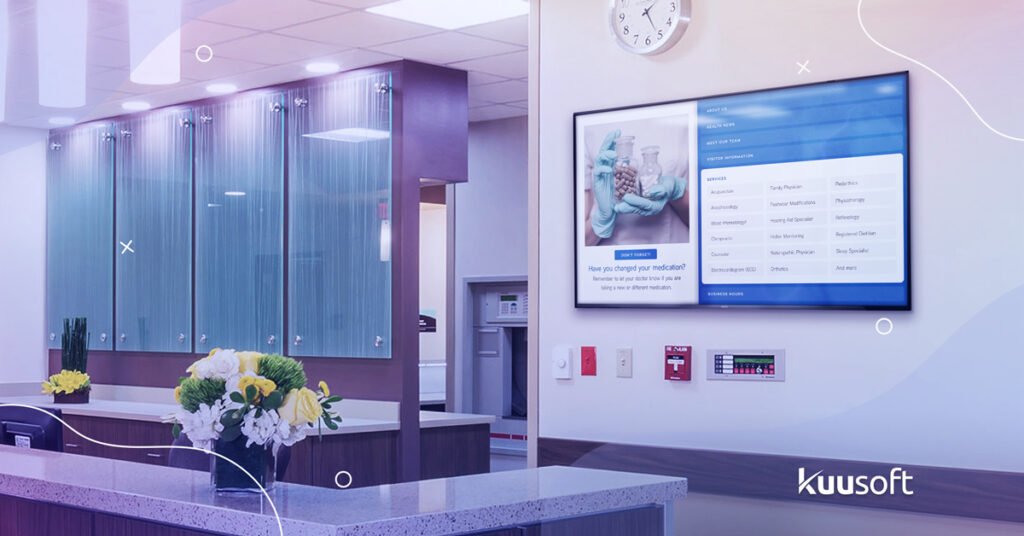

Hospitals don’t struggle with communication because they lack information. They struggle because the information doesn’t reach people when it matters. Static signs on walls haven’t been updated in months. Printed wayfinding maps are missing. A staff bulletin board is layered with outdated notices nobody has read. For patients who are already stressed, that kind of environment makes everything harder.
Digital signage addresses these gaps in ways that printed materials simply can’t. Screens can be updated instantly, adapt content throughout the day, and serve patients, visitors, and staff from a single network. The growing focus on healthcare digital signage benefits reflects a broader shift toward centralized, real-time communication systems that hospitals are adopting to move away from reactive, paper-based approaches.
Healthcare is one of the clearest examples, but the same shift is happening across corporate offices, manufacturing facilities, and large public venues. Anywhere information needs to move quickly across people, spaces, and teams, the limitations of static communication become a real operational problem. At scale, these gaps don’t just affect experience. They slow down operations and increase staff workload.
What makes this shift practical isn’t the hardware. It’s the ability to manage content centrally and push updates across dozens or hundreds of screens without relying on someone physically walking to each location.
Reducing Uncertainty Through Clearer Information
Patients who understand what’s happening during their visit tend to have a better experience, even when wait times are long. That’s not an assumption. The Agency for Healthcare Research and Quality has documented the link between clear communication and patient outcomes in care settings, pointing to how much confusion contributes to dissatisfaction and unnecessary distress.
Digital screens in waiting areas can display real-time wait time estimates, show which providers are currently available, and explain what to expect next in the care process. That kind of transparency doesn’t eliminate frustration, but it reduces the uncertainty that makes waiting feel worse than it is.
Lobbies and waiting rooms are the most obvious locations, but the same logic applies to pre-op areas, outpatient clinics, and discharge zones: anywhere patients are left waiting with limited information about what’s happening.
Staff Communication That Actually Reaches People
Clinical staff aren’t sitting at desks watching their inboxes. They’re moving between patients, handling time-sensitive tasks, and often unable to check a phone or computer for updates during a shift. Email and internal messaging systems are useful for some purposes, but they don’t work well for real-time operational information that needs to reach everyone immediately.
Screens placed in staff areas, including break rooms, nursing stations, and hallways between units, give hospitals a channel to display shift reminders, safety alerts, regulatory updates, and policy changes in a format that doesn’t require anyone to actively seek it out. The information is just there when staff pass by.
This is particularly useful for facilities with multiple buildings or departments, where consistent communication is harder to maintain manually. A centrally managed screen network means all locations receive the same update at the same time.
Wayfinding That Scales With a Complex Facility
Hospitals are notoriously difficult to navigate. Departments move. Wings get renamed. Construction projects close off usual routes. Printed wayfinding systems are expensive to replace and often lag behind these changes by weeks or months.
Digital directories and wayfinding screens can be updated within minutes. If a department moves floors or an elevator is temporarily out of service, the signage can reflect that the same day, without printing costs or a facilities work order.
Interactive kiosks in main lobbies take this further, letting patients search for specific departments or providers and get turn-by-turn directions tailored to where they are in the building. The Joint Commission has long emphasized that patient safety depends on effective care transitions and communication throughout a facility; accurate wayfinding is part of making that happen.
Compliance, Wellness, and Health Education
Beyond navigation and operations, screens in patient-facing areas offer a low-friction way to share health education content. A waiting room screen displaying hand hygiene reminders, vaccine information, or guidance on managing chronic conditions reaches patients during time they’d otherwise spend doing nothing.
This type of content doesn’t need to be elaborate. Short, plain-language messages that rotate between slides work well in this context. The screen becomes a passive but consistent presence, reinforcing health behaviors without requiring staff to deliver the information verbally each time.
The same approach works for compliance messaging aimed at visitors: mask requirements during flu season, hand sanitizer locations, and visiting hour policies. These aren’t messages that need to be delivered by a person at the front desk. A screen handles it reliably and consistently, regardless of who’s on shift.
Operational Efficiency Behind the Scenes
Administrators and operations teams benefit from digital signage in ways that aren’t always visible to patients. Conference room scheduling displays remove the ambiguity around room availability, cutting down on the time staff spend figuring out where to hold a meeting or discovering a room they reserved is already occupied.
Real-time dashboards in administrative areas can surface capacity data, patient flow metrics, or supply status, keeping department leaders informed without requiring them to pull reports manually or ask for updates. Hospitals that have moved in this direction tend to find that the value compounds across departments rather than staying contained to one use case.
The initial case for digital signage in healthcare often starts with wayfinding or patient communication. Over time, the same infrastructure supports staff communication, compliance reminders, operational visibility, and more. The flexibility is part of what makes it practical in an environment as complex and fast-moving as a hospital.
Healthcare facilities don’t need to overhaul everything at once. Starting with high-traffic areas and expanding from there is a straightforward path that lets teams learn the system before scaling it across the full facility. That scalability is what makes digital signage practical in environments where communication can’t afford to break down.