
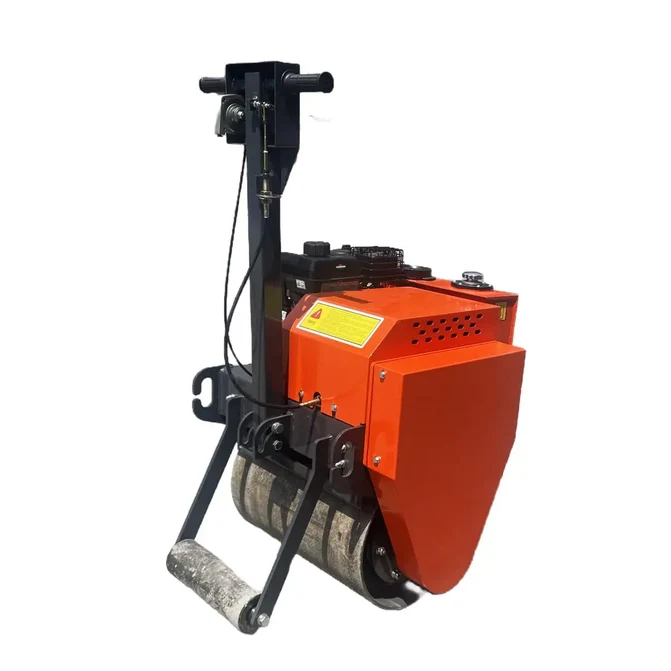

Across Canadian job sites in July, crews backfilling utility trenches and patching asphalt driveways need the loose fill under them to sit tight before the surface goes back down. A plate that shuffles in place can leave the seams of a narrow trench uneven, and an under-packed base soon slumps into ruts.
The machine built to press that fill down as it moves is the vibratory roller, and its steel drum changes how downward force reaches the ground compared with a flat plate.
A steel drum trades a broad foot for a rolling line of contact
A plate compactor presses its whole flat foot against the surface, then lifts and hops to the next spot. A vibratory roller instead carries a heavy cylindrical drum that touches the ground along a single narrow line across its width.
Because that contact is a line rather than a broad pad, the weight of the machine bears down on a small strip and presses it hard. As the drum turns, that loaded strip advances, so the compacting force travels with the machine instead of standing still in one place.
Vibration lets a light machine hit above its own weight
The five horsepower engine spins an eccentric weight inside the drum, and that imbalance shakes the drum many times each second. The rapid pounding coaxes grains of gravel and sand into a tighter arrangement than dead weight alone could ever manage.
This is why a compact vibratory roller can firm up a base that its static mass would barely dent. The vibration does the packing while the operator only has to guide the drum along its lane at a steady walking pace.
Moisture in the fill decides how well the shake works. A little water lubricates the grains so they slide into a tighter packing, while ground that is bone dry or sopping wet resists compaction no matter how long the drum works over it.
• Drum weight: presses the strip beneath it
• Eccentric shake: settles loose grains tight
• Forward roll: carries compaction along the lane
A narrow drum reaches the seams a wide plate cannot
The twenty-four inch drum is sized to drop into a utility trench and press the fill against both walls at once. Running the vibratory roller back and forth along the trench firms the backfill in even lifts rather than in scattered patches.
The same slim width tucks along foundations, curb lines, and the edges of a fresh slab. Operators often build a trench up in shallow layers, rolling each lift solid before the next load of fill goes in on top.
One drum and a walk-behind handle keep tight patches within reach
A single-drum layout puts all of the weight over one rolling face, so the operator can pivot the machine in a short radius. That agility matters when a patch sits between a curb and a parked trailer with little room to turn.
Guiding the machine by its handle also keeps the operator reading the surface underfoot. Slowing over a soft spot and adding a pass there is far easier than trusting a fixed count of laps to do the job.
The smooth face seals asphalt that a textured foot would scar
On a hot summer asphalt patch, the polished steel face of the drum irons the surface flat and closed. A plate compactor with a ribbed foot would leave marks, while the vibratory roller leaves a sealed finish that sheds rain.
Keeping the drum wet during asphalt work stops the tacky mix from sticking and tearing. A light film of water on the steel is usually enough to carry the patch to a clean, even skin.
• Wet drum: keeps hot asphalt from sticking
• Smooth steel: irons a sealed surface
• Even lifts: firm each layer before loading more
Thin lifts and repeated passes do what one thick layer cannot
Compaction reaches only so deep on each pass, so fill is placed and rolled in thin layers rather than dumped to full depth at once. A drum firms the top of a deep lift while the material below stays loose, hidden where nobody can see it until it settles under load later.
The number of passes matters as much as the weight. The first pass does most of the work, the next few gain a little more, and beyond that the drum only polishes a surface that is already as dense as it will get. Reading when to stop saves both fuel and time.
• Thin lifts: each layer firms all the way down
• First passes: gain the most density
• Extra passes: only polish an already dense base
Taken together, the rolling drum, the internal shake, and the slim width let one walk-behind machine firm trenches and seal patches that a hopping plate handles poorly. Each pass advances the compacting line a little further and leaves the ground ready for the surface above.
For summer trench and asphalt work on Canadian sites, a single-drum vibratory roller turns forward travel into steady, sealed compaction pass after pass, making it a practical choice for trench compaction solutions.