
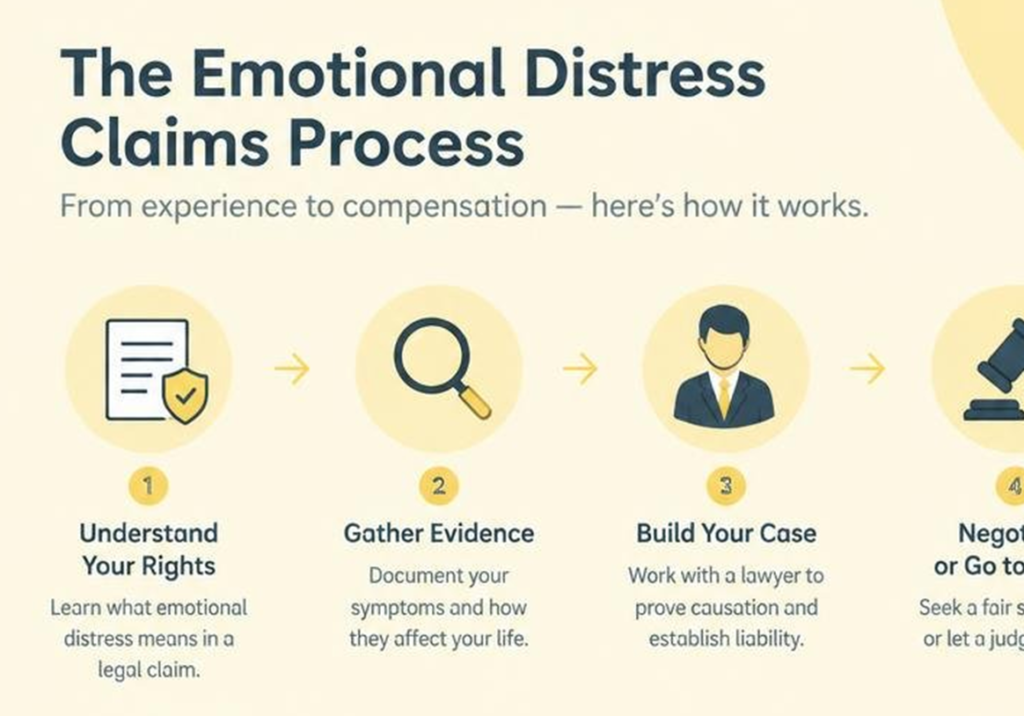

Understanding Legal Grounds for Emotional Distress Claims
An accident can cause more than just physical injuries. Often, the hidden emotional pain, like severe anxiety or PTSD, is just as hard to deal with. We know these psychological wounds can affect your daily life, work, and relationships. They can leave you feeling lost and unsure of your next steps.
This guide will help you understand your legal rights. We will explain what emotional distress means in a lawsuit and what kinds of compensation you can get. We will also show you what evidence you need to prove your claim. For those with invisible injuries, learning about Board-Certified emotional distress claims can be a key part of getting fair payment. We will also discuss filing deadlines, how much you might receive, and tax rules. This will give you the information you need to handle this difficult process.
When an accident leads to significant psychological suffering, it’s not just a personal struggle—it can also be a legal one. Emotional distress, in a legal context, refers to the mental anguish and suffering caused by another party’s negligent or intentional actions. This type of harm falls under “non-economic damages,” meaning it doesn’t have a direct monetary value like medical bills or lost wages. Instead, it encompasses the subjective experience of pain, suffering, and mental impact. To successfully claim compensation, you must establish “legal causation,” proving that the defendant’s actions directly led to your emotional distress. This forms the basis of “tort liability,” where the at-fault party is held responsible for the harm they caused.
Consulting an experienced personal injury lawyer is essential to determine the viability of your claim. They can help you navigate the complexities of proving causation and establishing the severity of your mental anguish in court.
Intentional Infliction vs Negligent Infliction in Accident Cases
Emotional distress claims typically fall into two main categories: Intentional Infliction of Emotional Distress (IIED) and Negligent Infliction of Emotional Distress (NIED). The distinction lies primarily in the defendant’s state of mind and the nature of their conduct.
Intentional Infliction of Emotional Distress (IIED) claims arise when a defendant deliberately or recklessly causes severe emotional suffering. The key elements for an IIED claim generally include:
- Extreme and Outrageous Conduct: The defendant’s actions must be so egregious and beyond the bounds of decency that they would cause distress to any reasonable person.
- Intent or Recklessness: The defendant must have intended to cause emotional distress or acted with reckless disregard for the high probability that emotional distress would result.
- Causation: The defendant’s conduct must be the direct cause of the emotional distress.
- Severe Emotional Distress: The plaintiff must have suffered severe emotional distress, which is often clinically diagnosed and significantly impairs daily functioning.
IIED claims are less common in typical accident scenarios but can arise in cases of extreme harassment, assault, or other deliberate harmful acts.
Negligent Infliction of Emotional Distress (NIED) claims, on the other hand, stem from a defendant’s careless or negligent actions that unintentionally lead to emotional distress. For an NIED claim, the elements typically involve:
- Duty of Care: The defendant owed a legal duty to the plaintiff (e.g., a driver’s duty to operate a vehicle safely).
- Breach of Duty: The defendant failed to uphold that duty (e.g., driving recklessly).
- Causation: The defendant’s breach of duty directly caused the plaintiff’s emotional distress.
- Severe Emotional Distress: Similar to IIED, the emotional distress must be severe and often medically documented.
NIED is more frequently applicable in accident cases, such as car crashes, where the at-fault driver’s negligence leads to psychological trauma for the victim. The primary difference between IIED and NIED is the requirement of intent or outrageous conduct for IIED, versus a breach of a duty of care for NIED.
Here’s a comparison of the legal elements:
Feature Intentional Infliction of Emotional Distress (IIED) Negligent Infliction of Emotional Distress (NIED) Defendant’s Conduct Extreme and outrageous; intentional or reckless Negligent; breach of a duty of care Intent Required? Yes, or reckless disregard No, actions are careless or accidental Physical Injury? Often not required Often required or a strict proximity standard Severity of Distress Must be severe and debilitating Must be severe and debilitating Common Scenarios Harassment, assault, deliberate threats Car accidents, medical malpractice, dangerous conditions
Evaluating Physical Impact, Zone of Danger, and Foreseeability Rules
The ability to sue for emotional distress without a physical injury varies significantly by state, often depending on whether the jurisdiction adheres to the “impact rule,” “zone of danger,” or “foreseeability standard.”
The “impact rule” is the most restrictive. In states like Florida, a plaintiff generally must have suffered some form of physical injury or physical impact from the accident to claim emotional distress damages. This means that if you only experienced emotional trauma without any bodily harm, your claim for emotional distress might be barred.
Many states have moved away from the strict impact rule towards more lenient standards:
- The “zone of danger” rule allows recovery for emotional distress if the plaintiff was in immediate danger of physical harm from the defendant’s negligent act, even if they were not physically injured. This often applies to bystanders who narrowly escaped harm.
- The “foreseeability standard” is the broadest. It allows recovery if it was reasonably foreseeable that the defendant’s actions would cause the plaintiff severe emotional distress. This standard may not require physical proximity or direct threat of injury, focusing instead on the reasonable expectation of harm.
These rules are particularly relevant for “bystander claims” where someone witnesses an accident involving a loved one. Some states allow bystanders to recover for emotional distress if they meet certain criteria, such as being closely related to the victim and witnessing the traumatic event firsthand. The manifestations of emotional trauma, such as PTSD, severe anxiety, or depression, must be clearly linked to the event and often require professional diagnosis to meet legal thresholds.
Calculating Compensation: What Is an Anxiety or PTSD Claim Worth?
Calculating compensation for emotional distress, especially for conditions like anxiety or PTSD, is complex because these are “non-economic damages” without a direct price tag. However, they are a significant part of personal injury claims. Settlement amounts for emotional distress vary widely depending on the severity of the condition, the evidence presented, and the specific state laws.
For instance, in California, emotional distress damages attached to a physical injury case frequently add between $50,000 and $500,000 to a settlement. Stand-alone IIED claims without an underlying physical injury might settle between $25,000 and $200,000. Overall, emotional distress lawsuit payouts can range from $5,000 for mild cases to over $500,000 for severe, intentional conduct with physical manifestations. Studies indicate that plaintiffs who included emotional distress claims alongside physical injury claims in auto accident cases recovered on average 1.8 times more than those who claimed physical injury alone.
Compensation for emotional distress typically covers both “economic damages” (quantifiable losses like therapy costs, medication, and lost income due to inability to work) and “non-economic damages” (the subjective experience of mental anguish, loss of enjoyment of life, and psychological suffering).
Multiplier and Per-Diem Methods for Emotional Distress Claims
Two common methods are used to estimate the value of non-economic damages, including emotional distress: the multiplier method and the per-diem method.
The multiplier method is often used when there are significant economic damages (medical bills, lost wages). It involves taking the total economic damages and multiplying them by a factor, typically ranging from 1.5 to 10. The multiplier chosen depends on the severity of the emotional distress, the duration of suffering, and the impact on the victim’s life. For example, a minor injury with short-term anxiety might use a 1.5x multiplier, while a severe, permanent psychological condition like PTSD could warrant a 5x or higher multiplier.
The per-diem method assigns a daily rate for each day the victim suffered from emotional distress, from the date of the accident until they reach maximum medical improvement or the distress resolves. This daily rate might be based on the victim’s daily earnings or a subjective value assigned to their suffering. This method is often used for shorter-term suffering or when economic damages are not substantial.
Here’s a general overview of settlement valuation ranges and calculation methods:
Severity Level Typical Settlement Range (California Example) Common Calculation Method Key Factors Influencing Value Mild $5,000 – $20,000 Per-Diem Short-term anxiety, minimal disruption, no formal diagnosis Moderate $20,000 – $100,000 Multiplier (1.5x – 3x) Diagnosed anxiety/depression, therapy needed, some daily impact Severe $100,000 – $500,000 Multiplier (3x – 5x) PTSD, major depression, significant life disruption, long-term therapy Catastrophic $500,000+ Multiplier (5x – 10x) Permanent psychological impairment, inability to work, severe functional loss These are general guidelines, and the actual value of a claim can vary significantly based on the unique circumstances of each case.
Key Factors Affecting Payouts: Severity, Duration, and Shared Fault
Several factors beyond the calculation method significantly influence the final payout for emotional distress:
- Severity of Distress: The more debilitating and pervasive the emotional distress, the higher the potential compensation. A formal diagnosis (e.g., PTSD, major depressive disorder, severe anxiety) from a mental health professional is crucial.
- Duration of Suffering: Long-term or permanent psychological conditions typically result in higher awards than short-term, transient distress. Consistent therapy and medication records help establish duration.
- Impact on Daily Life: How does the emotional distress affect your ability to work, engage in hobbies, maintain relationships, or perform daily tasks? Documentation of “daily functional disruption” is vital.
- Comparative Negligence: If you are found partially at fault for the accident, your emotional distress compensation may be reduced. Many states follow “comparative negligence” rules, where your recovery is diminished by your percentage of fault. For example, if you are 20% at fault, your emotional distress award would be reduced by 20%.
- Pre-existing Conditions: While a pre-existing mental health condition doesn’t automatically bar a claim, the defendant will argue that your distress isn’t solely due to their actions. However, if the accident aggravated a pre-existing condition, you can still seek compensation for the aggravation.
- Physical Manifestations: The presence of physical symptoms directly linked to emotional distress (e.g., ulcers, headaches, insomnia, digestive issues) can strengthen a claim, especially in states with stricter “physical impact” rules.
- Defendant’s Conduct: Cases involving “extreme and outrageous conduct” (IIED) or gross negligence may result in higher awards, and potentially “punitive damages” in some jurisdictions, intended to punish the defendant rather than compensate the victim.
Essential Evidence Required to Prove Psychological Trauma
Proving emotional distress in court requires “solid proof” and meticulous documentation. Unlike a broken bone, psychological trauma is invisible, making robust evidence critical to establishing its existence, severity, and causation. The “burden of proof” lies with the plaintiff, meaning you must present compelling evidence that your emotional distress is real, severe, and directly linked to the defendant’s actions.
Building Medical Documentation and Mental Health Records
The cornerstone of any emotional distress claim is comprehensive medical and mental health documentation. This includes:
- Formal Diagnosis: A diagnosis from a licensed mental health professional (psychologist, psychiatrist, therapist) for conditions like PTSD, major depressive disorder, generalized anxiety disorder, or other trauma-related conditions. This provides objective medical proof of your suffering.
- Therapy Records and Notes: Detailed notes from therapy sessions outlining your symptoms, progress, treatment plan, and the impact of the trauma on your life. Consistent attendance at therapy sessions demonstrates the ongoing nature and severity of your distress.
- Psychiatric Evaluations: Reports from psychiatric evaluations that assess your mental state, provide a diagnosis, and offer a prognosis for recovery.
- Prescription Logs: Records of any medications prescribed for your emotional distress (e.g., antidepressants, anti-anxiety medications) and their effectiveness.
- Personal Journals/Diaries: While subjective, a contemporaneous journal documenting your daily symptoms, emotional state, challenges, and how the distress impacts your life can be powerful evidence. It provides a personal account of your suffering over time.
- Expert Witness Testimony: A mental health professional can serve as an “expert witness” to explain your diagnosis, the causal link between the accident and your distress, and the long-term implications of your condition to a jury.
Bystander Claims and Proving Severe Harm for Emotional Distress Claims
For those who witness a traumatic event involving a loved one, “bystander claims” for emotional distress are a possibility in some jurisdictions, particularly those following the “zone of danger” or “foreseeability” rules. Proving severe harm in these cases requires specific elements:
- Close Relationship: The bystander must typically have a close familial relationship with the direct victim (e.g., parent, child, spouse, sibling).
- Immediate Perception: The bystander must have been present at the scene and directly perceived the traumatic event as it occurred. Hearing about it later is usually not sufficient.
- Severe Mental Distress: The emotional distress suffered by the bystander must be severe and beyond what a reasonable person would expect to endure. This often requires a formal diagnosis of conditions like PTSD.
- Witness Statements: Statements from other witnesses, friends, family, or even coworkers can corroborate the changes in your behavior, mood, and functional abilities after the accident. These statements provide external validation of your suffering.
Documenting the impact on your daily life, such as inability to sleep, recurring nightmares, panic attacks, social withdrawal, or difficulty returning to work, is crucial for both direct victims and bystanders.
Legal Timelines, Damage Caps, and Tax Implications of Settlements
Navigating the legal process for emotional distress claims involves understanding critical timelines, potential limits on damages, and the tax consequences of any settlement you receive. These factors can significantly impact your ability to recover compensation and the net amount you ultimately receive.
Statutes of Limitations and No-Fault Insurance Thresholds
One of the most crucial aspects of any legal claim is adhering to the “statute of limitations.” This is a strict deadline by which you must file your lawsuit after the incident. For emotional distress claims related to personal injury, the statute of limitations typically ranges from 1 to 3 years from the date of the incident in most states. For example, as of October 2026, Florida’s statute of limitations for personal injury claims (which often include emotional distress) is 2 years. Some states may have a “discovery rule,” extending the deadline if the emotional distress was not immediately apparent and could not have been reasonably discovered until a later date. Claims against government entities often have much shorter deadlines, sometimes as little as six months.
“No-fault states” introduce an additional layer of complexity. In approximately nine states with mandatory no-fault insurance schemes, you must first meet certain “no-fault thresholds” before you can sue an at-fault driver for non-economic damages like emotional distress. These thresholds can be:
- Serious Injury Threshold: You must have suffered a “serious injury” as defined by state law (e.g., significant disfigurement, permanent impairment, or death).
- Monetary Threshold: Your medical expenses must exceed a certain dollar amount.
Until these “tort thresholds” are met, your own Personal Injury Protection (PIP) insurance typically covers your medical expenses and a portion of lost wages, but not non-economic damages.
Taxability of Psychological Harm Awards and Non-Economic Damage Caps
The tax implications of an emotional distress settlement are a critical consideration. According to the Internal Revenue Service (IRS), “emotional distress settlements” are generally taxable as ordinary income, unless the emotional distress originates from a physical injury or physical sickness.
Here’s a breakdown based on IRS Section 104:
- Physical Injury/Sickness Connection: If your emotional distress is directly caused by a physical injury or physical sickness sustained in the accident, then the portion of your settlement allocated to that emotional distress is generally non-taxable. This is because damages received on account of physical injuries or sickness are typically excluded from gross income. This includes compensation for pain and suffering, mental anguish, and loss of consortium that are directly attributable to the physical injury.
- Pure Emotional Distress: If your emotional distress claim is “pure” – meaning it’s not linked to a physical injury (e.g., an IIED claim without physical harm) – then the settlement amount is generally taxable.
- Medical Expense Reimbursement: Any portion of the settlement that reimburses you for medical expenses related to your emotional distress (e.g., therapy bills) is generally non-taxable, as long as you haven’t already deducted those expenses.
- Punitive Damages: If your case includes “punitive damages” (awarded to punish the defendant for egregious conduct), these are always taxable, regardless of whether there was a physical injury.
It’s crucial to consult with a tax professional regarding your specific settlement to understand your obligations, as the allocation of damages in a settlement agreement can have significant tax consequences.
Regarding “caps on emotional distress damages,” many states do not impose limits on non-economic damages in most personal injury cases. For instance, California generally does not cap emotional distress damages, except in medical malpractice cases, where non-economic damages are capped (e.g., $430,000 in 2025, with annual increases). However, some states do have statutory limits on non-economic damages, so check your state’s specific laws.
Frequently Asked Questions About Accident-Related Anxiety Claims
We understand that you likely have many questions about pursuing a claim for accident-related anxiety and other forms of emotional distress. Here are answers to some common inquiries:
Can I sue for emotional distress if I didn’t suffer a physical injury?
Yes, in many jurisdictions, you can sue for emotional distress even without a physical injury, but the success of such “standalone claims” depends heavily on your state’s laws. As discussed, states vary in their requirements: some adhere to a strict “impact rule” requiring physical contact, while others follow the “zone of danger” rule or a broader “foreseeability standard.”
For “Intentional Infliction of Emotional Distress (IIED)” claims, a physical injury is often not required, as the focus is on the defendant’s extreme and outrageous conduct. However, for “Negligent Infliction of Emotional Distress (NIED)” claims, particularly those stemming from accidents, the absence of a physical injury can make it more challenging. You would typically need a severe psychological diagnosis (like PTSD or severe anxiety) and compelling evidence to link it directly to the defendant’s negligence.
How does comparative negligence impact an emotional distress settlement?
“Comparative negligence” significantly affects your emotional distress settlement if you are found to be partially at fault for the accident. Most states operate under either “modified comparative fault” or “pure comparative fault” systems:
- Pure Comparative Fault: In these states, your awarded damages (including emotional distress) are reduced by your exact percentage of fault. For example, if you are awarded $100,000 for emotional distress but found 30% at fault, you would receive $70,000.
- Modified Comparative Fault: These states also reduce your damages by your percentage of fault, but they have a threshold (often 50% or 51%). If your fault exceeds this threshold, you may be completely barred from recovering any damages.
Therefore, your “liability split” directly impacts the final compensation you receive for emotional distress. It’s crucial to understand how your state’s rules apply to your case.
Are emotional distress settlements taxable by the IRS?
As detailed earlier, the taxability of emotional distress settlements depends on whether the emotional distress is linked to a physical injury. If your emotional distress stems from a physical injury, the settlement portion allocated to that distress is generally non-taxable. However, if the “mental anguish taxation” is for purely emotional distress (without a physical injury), it is typically considered taxable income.
Any portion of the settlement used to cover “medical expense deductions” (like therapy or medication) is usually non-taxable, provided you haven’t already deducted these expenses. “Punitive damages” are always taxable. It’s common for a “1099-MISC reporting” form to be issued for taxable settlement amounts. Always consult with a qualified tax professional to understand the specific tax implications for your individual settlement.
Conclusion
Experiencing an accident can leave lasting emotional scars, manifesting as anxiety, PTSD, or other forms of psychological trauma. While these “invisible injuries” can be profoundly debilitating, the legal system offers avenues for compensation. Understanding the distinctions between intentional and negligent infliction of emotional distress, the various state rules regarding physical injury, and the critical role of evidence are paramount.
We emphasize the importance of “documenting psychological symptoms” promptly and consistently through medical and mental health professionals. Adhering to “timely filing” deadlines and understanding how factors like comparative negligence and damage caps can affect your claim are also crucial. Navigating “insurer negotiations” can be challenging, as insurance companies often try to minimize payouts for non-economic damages.
By meticulously gathering evidence, understanding the legal landscape, and seeking experienced legal counsel, you can significantly strengthen your claim for emotional distress and work towards securing the compensation you deserve to aid in your recovery.
Read Also:- flypapermagazine.com