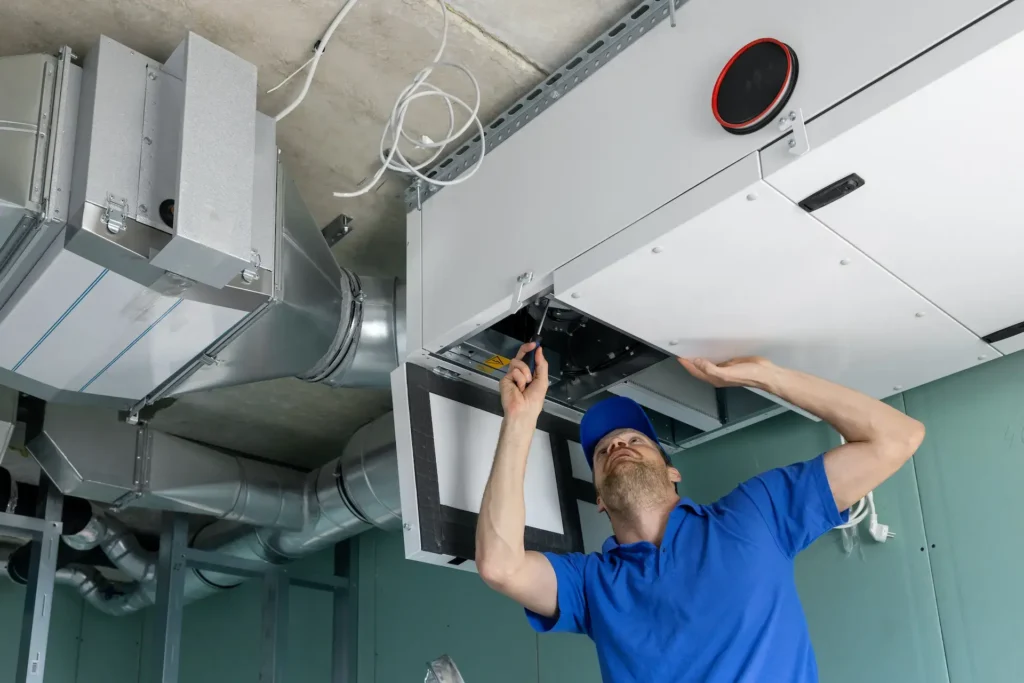

Replacing an HVAC system is often seen as an equipment decision, yet duct design determines whether the new system can actually deliver comfort, efficiency, and reliable operation. If ducts are undersized, leaky, poorly balanced, or missing proper return pathways, a new unit may still produce the same hot and cold spots, noisy airflow, and long run times that triggered the replacement in the first place. Duct issues can also cause mechanical stress by raising static pressure, limiting airflow across coils, and forcing blowers to operate outside healthy ranges. HVAC contractors inspect duct design before replacement to verify that the air distribution system matches the home’s needs and the new equipment’s airflow requirements. This inspection helps avoid oversized or undersized selections and reduces the risk of callbacks due to comfort complaints that equipment alone cannot resolve.
Duct design sets system results.
- Comfort problems often start in distribution.
Many homeowners report that certain rooms never cool or heat properly, and those patterns often trace back to the distribution system rather than to equipment capacity. Contractors evaluate duct layouts to see how supply runs feed each room, where trunks split, and whether long runs, sharp turns, or crushed flex duct starve distant branches. They also check for signs of past adjustments, such as closed registers, which can indicate a balancing problem or a mismatch between duct sizing and room loads. Uneven airflow can be intensified by building features such as vaulted ceilings, sun-exposed rooms, or additions, and duct design must account for those loads with adequate supply and return paths. Without duct inspection, a replacement can become a repeat of the same problems, just with a newer machine. Inspecting the design also helps contractors identify whether comfort complaints are related to return placement, duct leakage into attics, or poor airflow pathways created by closed interior doors. These factors matter because they influence how much conditioned air actually reaches living spaces, not just how much the unit can produce at the coil.
- Static pressure and airflow determine equipment performance.
New systems have specific airflow requirements, and duct design directly controls whether that airflow is achievable. Contractors measure or estimate static pressure and compare it to the blower’s capability because high resistance can reduce airflow, lower capacity, and lead to coil icing in cooling mode or limit trips in heating mode. A replacement that increases efficiency can still perform poorly if the duct system forces the blower to work too hard. Variable-speed blowers may ramp up to maintain airflow, but that can raise noise and energy use while hiding the underlying restriction. A HVAC Contractor serving homeowners in the greater Sacramento area may explain that an equipment upgrade without duct corrections can feel disappointing because the system runs but never delivers even temperatures, especially during peak summer heat. Duct inspection also checks filter setup, coil cleanliness, and return grille sizing, as these components affect pressure just as duct sizing does. When airflow and pressure are known, the contractor can choose equipment that matches the duct reality or propose duct improvements that allow a better-performing system design.
- Duct leakage and insulation change true capacity.
Ducts that leak into attics, crawlspaces, or wall cavities waste conditioned air and can pull in hot, dusty, or humid air, increasing the load. Contractors inspect for leakage at plenums, boots, seams, and disconnected runs because leakage can make a properly sized system feel undersized. They also assess duct insulation because heat gain in attic ductwork can raise supply air temperature before it reaches rooms, reducing comfort and increasing run time. A new, more efficient system can still struggle if the duct system is losing a significant percentage of air before delivery. Contractors may use pressure testing or targeted inspections of common leak points to estimate the amount of air loss. They also check whether return ducts are leaking, because return leaks can pull attic air into the system, raising indoor humidity and temperature. Fixing duct leakage before or during replacement improves delivered capacity, often allowing smaller equipment sizing and better humidity control. In that sense, duct inspection is not an extra step; it is a way to ensure the home receives the cooling and heating that the equipment is capable of producing.
Duct checks prevent repeat problems.
HVAC contractors inspect duct design before system replacement because ducts determine how effectively heating and cooling reach each room and how hard the equipment must work to move air. Distribution issues can cause uneven comfort, noise, and high static pressure, reducing airflow and stressing blowers, leading to icing or limited trips even with new equipment. Duct leakage and poor insulation can waste capacity and distort sizing decisions, making systems feel undersized or causing oversizing side effects like short cycling and poor humidity control. By evaluating duct layout, returns, leakage, and pressure limits, contractors can recommend targeted duct improvements and choose equipment that matches the home’s real delivery conditions. This approach reduces callbacks, improves comfort, and helps the replacement perform reliably for years.