

Shoppers always want faster, easier, and more personalized experiences, so stores keep changing to meet these needs. Robots in stores help make things run more smoothly and improve how customers feel about shopping. Service robots work best when they are not only independent but also guided by remote operators. Having humans involved helps robots in the retail industry make better decisions, interact kindly, and solve problems effectively.
This article looks at how robots controlled from a distance are changing customer service, improving how stores work, and giving shoppers a better experience.
Beyond Autonomy: The Crucial Role of Remote Operators in Retail CX
Sometimes robots can’t handle things on their own, so a person steps in to help out and make sure everything goes smoothly for the customer.
Even though AI and machine learning have given robots cool independent abilities, they can sometimes struggle in complicated, unexpected situations with people. This is where the role of the remote operator becomes invaluable. These skilled professionals make sure technology helps improve the customer experience by connecting human understanding with robotic efficiency.
A remote operator is a trained individual who supervises, guides, and intervenes in the operation of robots from a remote location. The robot operators aren’t just tech experts; they’re also the ones who bring a human touch, able to understand complex info, make smart choices, and give personalized help. When a robot faces something it can’t handle on its own, like a tricky question, an unexpected hurdle, or a delicate issue, a person can jump in to help. This ensures that the customer experience remains positive and seamless. A robot that talks like a human might have a hard time with tricky or emotional questions. A remote operator can listen through the robot’s audio and take over the conversation to give a more understanding and accurate response than a pre-programmed AI. Helping customers quickly turns a problem into a chance for great service and keeps them coming back.
The service robots industry is growing fast and is expected to keep getting bigger. By 2032, the global retail robots market is expected to be worth $104.64 billion, growing at a 30% annual rate from 2025 to 2032. This growth is driven by the need to address labor shortages, improve efficiency, and meet evolving consumer demands. Remote operators are important for growing this area. They provide a flexible workforce to manage robot fleets, helping to ensure good customer results and effectively represent the brand.
Enhancing In-Store Customer Interactions with Remotely Operated Robots
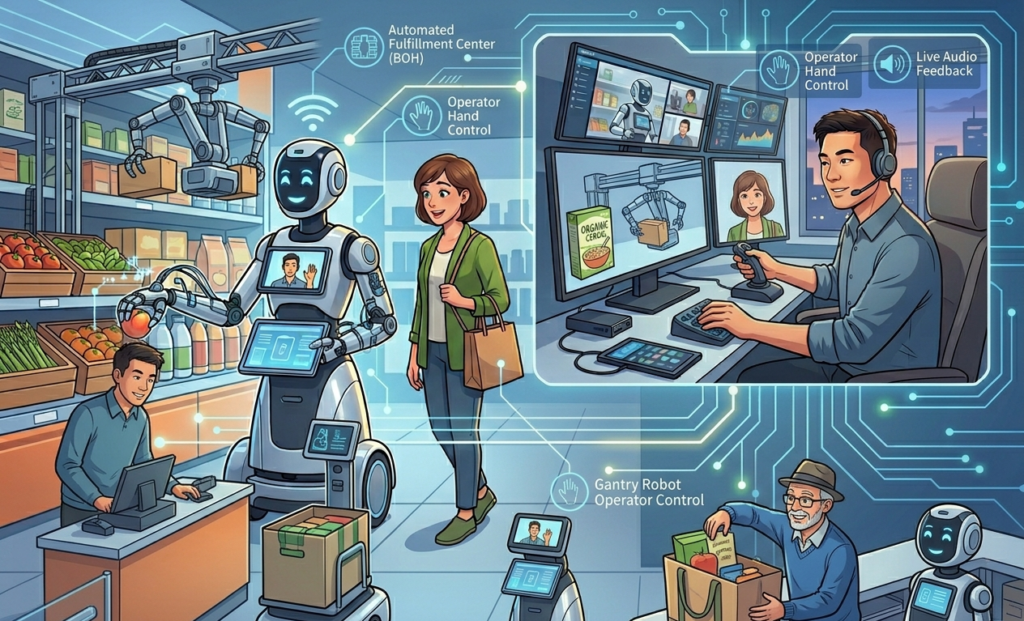
Stores are turning into places where customers interact more, and robots controlled from afar are leading this change. Robots that help customers, like humanoid robots and assistants, are now important for making in-store experiences better.
When guided by remote operators, these robots transform into sophisticated concierge solutions. They can say hello nicely, give personal suggestions using real-time info or customer profiles, and share detailed product details. For example, a remote operator can direct a humanoid assistant to guide a shopper to a specific item, offer alternatives if it’s out of stock, or even help navigate complex product choices. Having a personal touch, even from a robot, really boosts the customer experience. It’s really helpful for handling sensitive questions or private products because a person can handle these better than a bot.
Interactive kiosks also benefit immensely from remote oversight. A remote operator can control changing content, help customers right away, and tailor interactions based on what customers do or ask for. It makes things more interesting and helpful, going from just getting information to really solving problems. Robots, guided by operators, can make customers happy and create lasting experiences, which are important for building customer loyalty.
Remote operators can use the robot to help with tasks that need understanding or problem-solving for customers. They can use natural language processing and smart voice assistants, improved by human insight, to help solve customer problems and communicate clearly. Robots take care of the boring or number-crunching tasks, while humans add empathy, flexibility, and good communication, making shopping better for customers.
Revolutionizing Store Operations and Efficiency Through Remote Oversight
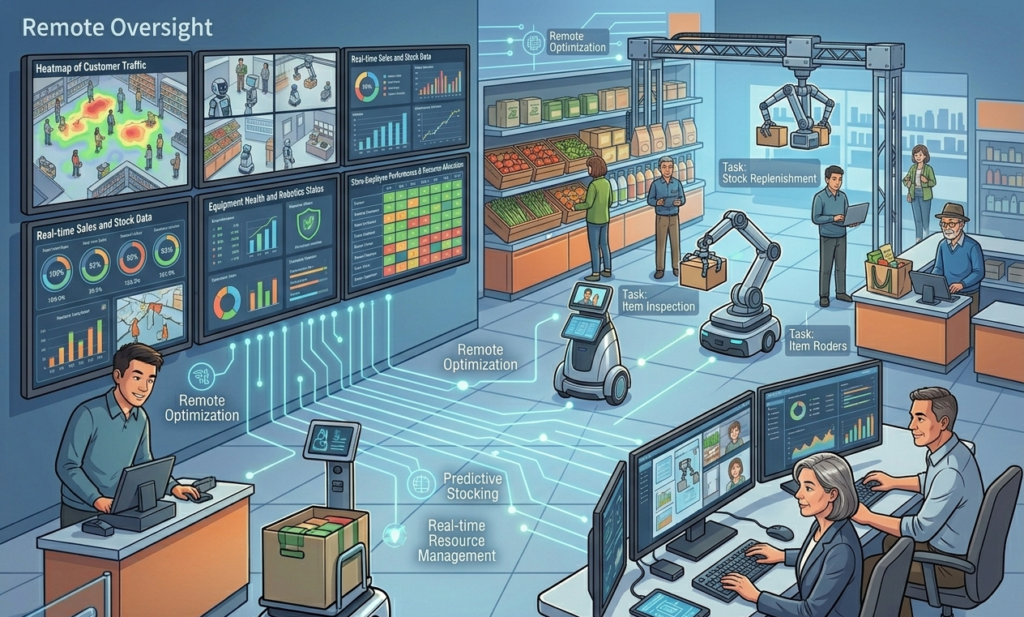
Robots that can be operated from a distance help make store operations much more efficient and effective, not just in dealing with customers. Retailers can make shopping better for customers by managing robots that handle behind-the-scenes tasks.
One of the most critical areas is inventory management. Robots like the Tally robot, with RFID scanners and readers, can keep track of inventory accurately all the time. When a remote operator watches these robots, they can check the shelf data, figure out any oddities, tell the robot to check certain spots again, or decide what to do based on sales info. The inventory tracking helps keep products in stock so customers can get what they want when they need it. Keeping track of inventory like this helps avoid annoying customers and missing out on sales, which is really important in retail.
Beyond inventory, remote operators play a crucial role in optimizing order fulfillment. For store owners with pick-up or online orders, robot arms can help speed things up. A remote operator can watch over and check the picking, packing, and staging of orders to make sure everything is done right and quickly, especially when it’s busy. This ability also works for final delivery situations, where people might control delivery robots from a distance or make sure the store pick-up spots are always prepared.
Autonomous cleaning robots, like those performing floor scrubbing, also benefit from remote oversight. These robots can clean the store by themselves and keep it nice, but someone can watch them from afar, move them around if something’s in the way, or plan when they should clean so they don’t bother shoppers. This helps keep the store clean and friendly, which is important for a good customer experience.
Security robots that you can control from a distance can make security better and offer a hands-on way to keep things safe. Operators watch live feeds, handle alerts, and direct robots to check on possible security issues, keeping everyone safe. Using sensors and people together makes shopping safer and more reliable. Robots send data all the time, and teams that manage them from afar use this information to help improve supply chain strategies and make operations stronger.
The Technology Underpinning Remote Robot Operations for CX
Using advanced tech, remote-controlled robots run smoothly to improve customer experience. The system relies on Artificial Intelligence (AI) and machine learning (ML) to help robots do complex things. AI helps robots move around stores, avoid bumping into things, and do their tasks. ML allows these robots to learn from their experiences, improving their performance over time.
However, AI and ML alone cannot fully replicate human judgment. This is where sensor technology plays a critical role. Robots have sensors like cameras, LiDAR, and ultrasonic sensors that collect a lot of information about what’s around them. This data is then transmitted, often via stable IP address connections, to remote operators. Robots use visual recognition software to see products, read labels, and find mistakes on shelves, and People controlling things from afar can improve these tasks by watching, correcting mistakes as they happen, or taking over when the conversation gets tricky. Then they send this information for analysis.
Robots need to understand and talk to customers, so using Natural Language Processing and voice assistant features is very important. These technologies enable robots to understand spoken commands and respond in a human-like manner. Remote operators can make things better by watching talks, fixing things right away, or taking over when the conversation gets tricky. AI and humans work together to make sure robots give customers accurate info and good chats, making the customer experience better.
The scalability of these solutions is often facilitated by Robotics as a Service (RaaS) models. Stores can get robots, software, and support services, like remote operation help, through subscriptions without having to pay a lot of money up front. This makes it easier for more businesses to use these new in-store technologies. Making sure data moves and messages get through smoothly is important. Strong networks help robots communicate with their remote controls, making the whole store run well.
Addressing Challenges and the Future of Remote Robot Operation in Retail
Using robots that can be controlled from afar can greatly enhance the customer experience, but retailers need to tackle some issues to make it work well. A big reason for using robots, even the ones controlled from afar, is that there aren’t enough workers. Robots can help with jobs like keeping track of inventory and cleaning, so human workers can focus on more important tasks. By 2025, stores think they’ll be able to automate up to 70% of regular tasks, so workers can focus more on helping customers.
However, the reliance on technology also brings potential vulnerabilities. Privacy concerns and ethical considerations are paramount. Retailers must ensure transparency with customers regarding robotic operations and data collection. Good security measures are really important to stop online attacks or keep hackers out of robot controls. Robots can help with security, but they also need protection from bad actors, which might mean having their own defense systems.
It’s really important to keep a steady connection and fast response times for real-time remote control. It’s important for robots to quickly do inventory checks and help customers to keep them happy. Better visual recognition software and AI are cutting down the need for people, but for tricky situations, a human is still needed.
Looking ahead, the future of remote robot operation in retail is bright. We can look forward to smarter robots that act more like humans, more delivery robots to get stuff to us faster, and self-driving shopping carts that can be controlled from afar. As AI develops, remote operators might focus more on big-picture tasks and solving problems instead of just controlling things directly. Most U.S. shoppers from a survey like robots in stores, which shows they’re open to these changes, and it’s good for customer loyalty.
Conclusion: The Symbiotic Future of Retail CX
The integration of remotely operated robots represents a significant leap forward in enhancing the customer experience within the retail industry. Far from replacing human interaction, this technology amplifies it, creating a powerful synergy between robotic efficiency and human empathy. Remote operators serve as the crucial link, ensuring that in-store robots not only perform tasks flawlessly but also interact with customers in a nuanced, helpful, and engaging manner.
From optimizing inventory management and order fulfillment to personalizing in-store interactions and bolstering security service, the applications are vast and impactful. Technologies like Artificial Intelligence, machine learning, RFID scanners, and advanced sensor technology empower robots, while remote operators provide the critical judgment, adaptability, and understanding needed for exceptional customer service.As the Service Robots Industry continues its rapid growth, retailers that embrace the human-in-the-loop model will be best positioned to meet evolving customer expectations, overcome labor shortages, and build lasting customer loyalty. The future of retail CX is not about robots alone, but about intelligent collaboration, where human expertise and robotic capabilities work in concert to create seamless, memorable, and ultimately more human shopping journeys.
Read More Blogs