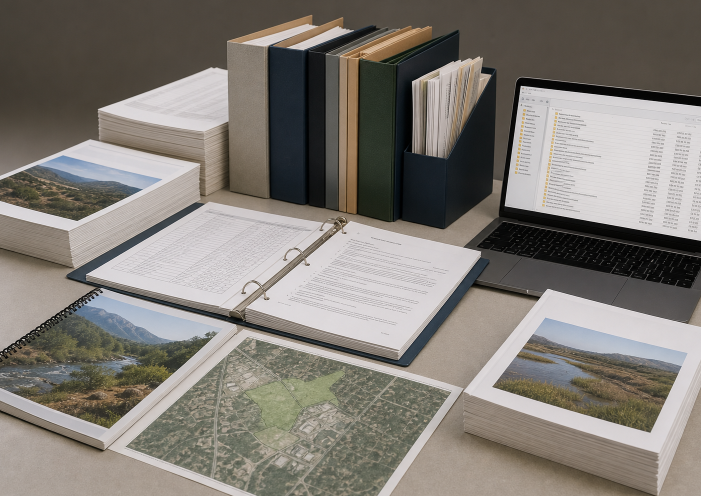

A CEQA administrative record is the organized body of materials showing what a public agency considered before it approved, denied, or changed a project. For agencies, applicants, consultants, and community participants, record-building is not merely a litigation task. It is a practical way to make the environmental review process understandable, consistent, and accountable. Because courts generally examine the materials that were before decision-makers when they acted, a complete record helps demonstrate the factual basis for the agency’s conclusions. Teams should understand the standard of judicial review under CEQA in California courts. Still, the most useful habit is simpler: preserve the path from project facts to environmental analysis to findings to final action.
Why the Record Matters
The record tells the story of a decision. Consider a housing proposal involving traffic, noise, water supply, and wildfire concerns. A reliable file should enable a new reviewer to identify the project description, locate the technical studies, see the public’s concerns, understand the staff’s analysis, and locate the adopted findings. A stack of reports alone is not enough if it does not show how the agency reached its decision.
What Belongs in the Record
The precise contents will vary by project and agency, but project teams should collect materials as they are created rather than trying to reconstruct them after approval. Common categories include:
- Applications, revised project descriptions, plans, maps, and photographs.
- Initial studies, environmental documents, technical reports, and data.
- Staff reports, memoranda, presentation materials, agendas, notices, and resolutions.
- Public comments, responses, hearing minutes, transcripts, and exhibits.
- Relevant correspondence among the agency, applicant, consultants, and other public bodies.
When the record is prepared for court, California’s administrative record rule requires a detailed index that identifies documents, dates, descriptions, and the page on which each item begins. That filing standard is also a useful organizational model from the first day of review.
A Step-By-Step Record-Building Process
1. Set a protocol early
Assign a record coordinator and establish a shared repository, file-naming convention, and retention process. Clarify who saves emails, attachments, consultant work product, revised plans, and materials supplied by the applicant.
2. Maintain a document log
Track each item’s title, date, author, recipient, version, and storage location. Note whether staff, consultants, the applicant, or a decision-making body reviewed it. Label duplicates and superseded versions instead of silently deleting them.
3. Connect evidence to findings
For every significant finding, identify the studies, comments, analysis, or other evidence that support it. If the project changes, document what changed, whether additional review occurred, and how the updated information affected the recommendation.
4. Review before the hearing and close carefully
Confirm that cited reports, appendices, maps, and links work correctly, and that decision-makers receive the same core materials. After action, preserve final documents, prepare the index, and identify late submissions with a clear explanation of how they were handled.
Common Record Gaps and Mistakes
Small filing problems can create larger questions about the quality of review. Frequent issues include inconsistent project descriptions, missing attachments, important email discussions stored outside the project file, unsupported conclusions, and informal statements that never appear in the record. Other avoidable mistakes include failing to explain why a technical report was accepted or rejected, overlooking comments that identify a new environmental issue, or adding consequential material after approval without describing its status. The goal is not to preserve every duplicate or casual communication. It is to retain materials that bear on the agency’s environmental analysis and decision.
Managing Emails, Files, and Digital Evidence
Digital materials deserve the same discipline as paper records. Use a central repository with controlled access, searchable formats, consistent dates and version numbers, and a dependable backup process. Preserve attachments with the emails that discuss them, and keep a log when documents are corrected, replaced, or withdrawn.
- Avoid vague names such as “final-final2.”
- Separate working drafts from materials submitted to or relied on by the agency.
- Use searchable PDFs where practical and verify that scans are readable.
- Review shared drives, email folders, and consultant transfer folders before certification or production.
Handling Public Comments With Care
Public comments may provide local facts, point out omitted information, or draw attention to impacts that warrant further evaluation. Group comments by topic, such as traffic, air quality, noise, water, safety, or biological resources. A comment matrix can identify the issue raised, the relevant record materials, the response, and where that response appears. Repeated or emotional comments should not be dismissed solely because of their tone. The useful question is whether a comment raises a substantive issue, provides evidence, or calls for a response that helps explain the agency’s reasoning.
Practical Issues To Watch
CEQA procedures, exemptions, streamlining provisions, and judicial interpretations continue to develop. Project teams should confirm the statutes, regulations, guidance, and case law in effect on the date of each major decision rather than relying on an older template. Faster review does not eliminate the need for clear findings and organized support. For example, a California Supreme Court CEQA ruling on June 26, 2026, addressed the Class 1 exemption and the meaning of negligible expansion of use. The practical lesson is to document the factual basis for an exemption determination, including the project’s existing conditions and the proposed change.
Final Pre-Approval Checklist
- Is the project description accurate, current, and consistent across documents?
- Are major technical studies, maps, exhibits, and appendices complete and readable?
- Do findings and mitigation measures clearly match supporting evidence?
- Can reviewers quickly locate public comments and agency responses?
- Are late materials, duplicates, drafts, and superseded versions clearly labeled?
- Does the index accurately describe every included document?
- Can a new reviewer understand the decision without relying on oral explanations?
Common Questions
Who builds the administrative record?
The lead agency usually controls the official record, although applicants, consultants, and other agencies often provide essential supporting materials.
Are emails part of the record?
They can be, particularly when they contain project facts, analysis, recommendations, or communications tied to the agency’s decision. Teams should follow applicable retention and disclosure requirements.
Can drafts be included?
Drafts may help show the review process, but the final compilation should clearly distinguish drafts from materials actually relied upon for the decision.
What if a document is missing?
Identify the gap, locate the original if possible, and document how the issue was handled. Do not quietly recreate or backdate a document after the fact.
Conclusion
A reliable CEQA administrative record starts with steady project-management habits, not a last-minute scramble. Clear descriptions, organized evidence, complete documentation, thoughtful responses to public comments, and disciplined digital storage help preserve the reasoning behind key decisions. Teams should maintain consistent file names, track revisions, document important communications, and ensure that supporting studies can be linked to the conclusions they inform. Regular quality checks can also help identify missing materials, conflicting versions, or unclear references before the record is finalized. When records are built carefully throughout the review process, they become easier to navigate and more useful to everyone involved. A well-maintained administrative record can help the public, agencies, project teams, and courts understand what information was considered, how concerns were addressed, and how the project ultimately reached its outcome.
Read Also: flypapermagazine.com