
Late summer is when fence lines finally get finished
Across much of the United States, late summer is when property owners and small utility crews close out the pole work waiting since spring. Setting a heavy pole by hand is slow and awkward, and a skid steer pole setter removes most of that struggle.
The task looks simple from a distance. A pole must be lifted, carried to the hole, tipped from horizontal to vertical, and held steady while backfill goes in around it. Every one of those steps is where crews lose time or get hurt.
Righting an existing pole is not the same as driving one
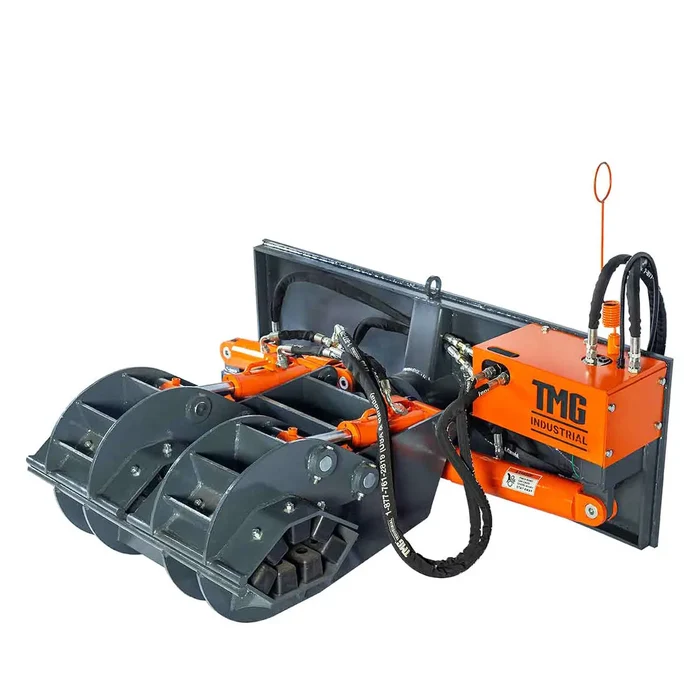
Some machines drive a post into undisturbed ground by force, breaking soil with impact energy. A pole setter does something different. It clamps an existing pole, rotates it upright, and lowers it into a hole bored beforehand, so the ground never fights the attachment.
That distinction shapes the entire design. Nothing about the attachment needs to survive hammering, and everything about it needs to hold a heavy, awkward object without letting it slip. The engineering effort goes into grip, rotation, and fine control rather than absorbing shock.
A rope and two workers used to do this job
The traditional method puts people directly beneath a leaning pole while others haul on ropes to steady it. It works, but the margin for error is thin and the physical effort considerable. Mechanizing the lift moves the crew out from under the load entirely.
Productivity follows safety here rather than competing with it. A crew in rural Missouri setting corner poles for a livestock enclosure found that auger time became the limiting factor instead of handling time. A pole setter changed which part of the day was the bottleneck.
Clamping force must match the timber, not overwhelm it
The claw closes on a working diameter from three inches to sixteen inches. That span covers everything from a stout fence corner to a full utility pole. A narrow post needs pressure enough to stop slipping without crushing wood, while a large pole needs real force.
Lift rating tells the other half. A capacity near twenty-five hundred pounds is not about the heaviest pole imaginable but about carrying an ordinary one with margin. A load swinging on a raised arm behaves far worse than the same weight sitting still.
Rotation is what lets the operator chase the hole
The claw on a pole setter turns through roughly one hundred degrees. The pole swings from lying flat to standing plumb without the machine ever repositioning. The operator brings it to vertical, walks the butt over the bore, and eases it down.
Fine control at that moment matters more than raw power. A pole arriving close to plumb drops in cleanly, while one arriving at an angle scrapes the sidewall and widens the bore. That means more backfill, more tamping, and a weaker set.
The load sits high, weighs plenty, and forgives no slope
A raised pole puts mass well above the machine. The center of gravity shifts with every degree of rotation. Working across a side slope with a pole in the air turns a manageable load into a tipping one, and it deserves real caution.
Sensible practice here is unglamorous. Keep the load low while traveling, approach the hole square, and keep everyone outside the swing radius. Confirm the jaws of the pole setter have closed on solid wood rather than bark that may peel under weight.
The attachments that share this corner of the work
• Earth auger: bores the hole before the pole arrives
• Post driver: impacts smaller posts without a bored hole
• Grapple bucket: gathers loose timber around the yard
• Pallet forks: carries bundled poles across the site
Where the format earns its keep and where it does not
• Strength: keeps people out from beneath a leaning pole
• Strength: one operator completes what a crew handled
• Limit: needs a hole bored well in advance
• Limit: high loads demand level and stable ground
Measured against a crane or a dedicated line truck, a pole setter gives up reach and refinement. What it returns is something the loader a contractor already owns can carry. For a fence line, a pavilion post, or a rural service pole, that trade is right.
Smaller crews keep taking on work that once needed a line truck
Labor shortages and the cost of specialized trucks have pushed pole work toward general purpose machines carrying capable attachments. Manufacturers answered by building handling tools around the skid steer rather than scaling down utility equipment. The gap in real capability keeps narrowing.
That shift is why the attachment range from TMG Industrial includes handling tools built around the loader most crews already park in the yard.