

Failing to track legacy property hazards risks severe fines and stop-work orders. This blog decodes Australian compliance, detailing how independent Asbestos Management Plans, continuous air monitoring, and a proactive 5-year review cycle mitigate liabilities and ensure structural and workplace safety.
Key Takeaways
- Legal Accountability: Commercial buildings built before 2003 require a strict Asbestos Register and Management Plan maintained by the PCBU
- Mandatory Monitoring: Friable asbestos disposal requires independent, continuous air monitoring by a Licensed Asbestos Assessor to hit safe thresholds
- Proactive Lifecycle: Managing asbestos requires regular five-year statutory re-inspections alongside rapid four-step incident protocols for accidental exposure events
Managing legacy property portfolios involves navigating strict statutory frameworks for commercial property owners, facility managers, and Persons Conducting a Business or Undertaking (PCBUs) across Australia.
Under regional Work Health and Safety (WHS) Regulations, failing to actively monitor and document hazardous materials leads to:
- severe operational liabilities
- stop-work orders, and
- substantial financial penalties.
This applies to the presence of Asbestos Containing Materials (ACMs) in properties in Australia, especially those operated and built during the 1990s. You need to assess your site to identify any presence and remediate them if found, because ACMs have been banned since 2003. This blog will explain how it is done.
Decoding the Legal Mandates: Asbestos Registers vs. Management Plans
Property owners frequently confuse an Asbestos Register with an Asbestos Management Plan (AMP), yet they serve completely different statutory purposes.
What is the Difference Between an Asbestos Register and an AMP?
An Asbestos Register identifies the exact location, type, and structural condition of all suspected and confirmed Asbestos-Containing Materials (ACMs) on-site.
An Asbestos Management Plan outlines the specific operational procedures, safety controls, risk mitigation actions, and clear response timelines used to manage those identified risks over time.
Key Compliance Requirements
- Statutory Threshold: Buildings constructed before December 31, 2003, must maintain a valid Asbestos Register if commercial workplace operations occur on-site.
- Who is Responsible: The PCBU holds ultimate legal accountability for maintaining, updating, and executing the site compliance framework.
- Accessibility: The AMP must be readily available to workers, facility managers, health and safety representatives (HSRs), and incoming civil or trade contractors before any structural work begins.
| Material Type | Core Characteristics | Legal Mandates (WHS Regulations) | Air Monitoring Requirements |
| Friable Asbestos (Class A) | Can be crumbled or pulverised by hand pressure when dry (e.g., pipe lagging, spray-on insulation, limpet splash). High risk of immediate fibre release. | Mandatory Asbestos Register & AMP. Disposal must strictly be performed by a Class A Licensed Contractor. | Statutory Mandate: Continuous background, enclosure, and clearance boundary air monitoring conducted by an independent Licensed Asbestos Assessor (LAA). |
| Non-Friable Asbestos (Class B) | Bonded matrix material (e.g., AC sheeting, fibro, vinyl floor tiles, corrugated roofing). Cannot be easily crushed unless damaged or weathered. | Mandatory Asbestos Register & AMP if built pre-2003. Disposal >10m² requires a licensed Class B or Class A contractor. | Best-Practice Risk Control: Highly recommended if the material is weathered, structural cutting/drilling is required, or if PCBUs need verifiable safety records. |
Table 1: Statutory Framework & Operational Requirements
The Science of Air Monitoring: When is it a Legal Necessity?
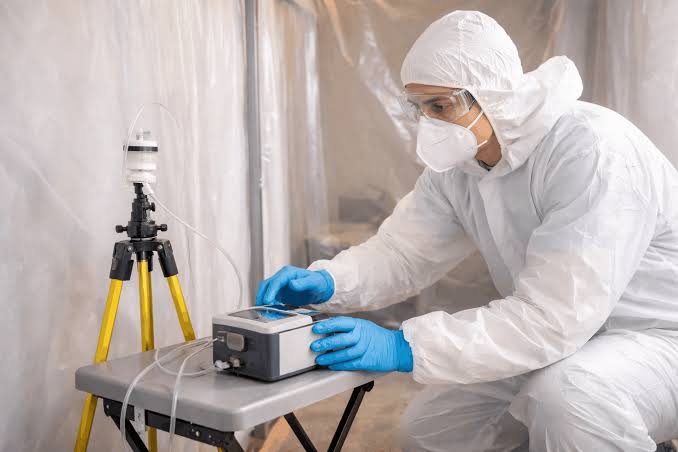
Asbestos air monitoring serves as the technical validation of an environmental containment strategy. Utilising the membrane filter method, specialists measure respirable fibre concentrations to confirm that protective enclosures are performing as designed and that ambient breathing zones remain completely safe.
A clean clearance pass relies on a critical threshold of less than 0.01 fibres/mL. Air monitoring protocols fall into four specific operational categories:
- Background Monitoring: Conducted prior to any site disturbance to establish a verifiable baseline of ambient air quality.
- Exposure Monitoring: Sampling executed within the breathing zones of workers to assess individual risk profiles and validate Personal Protective Equipment (PPE) selections.
- Control Monitoring: Continuous testing placed outside the boundaries of a containment enclosure to ensure that no structural leaks or fibre migration are affecting surrounding areas.
- Clearance Monitoring: Aggressive static sampling performed post-decontamination to verify the safety of the environment before containment structures are dismantled.
To preserve strict legal protection and avoid structural conflicts of interest, PCBUs must engage an independent Licensed Asbestos Assessor (LAA) alongside NATA-accredited laboratory facilities to manage this testing process.
Proactive Maintenance: The 5-Year Review and Re-Inspection Lifecycle
Asbestos management is not a static exercise. Environmental wear, mechanical vibrations, building movement, and minor maintenance works constantly alter the stability of ACMs.
Treating risk management as a one-off task leaves organisations exposed to regulatory penalties. Here’s what modern asset management relies on to capture the changes in ACMs.
| Milestone Event | Technical Trigger | Operational Action Required | Compliance Deliverable |
| Routine Review | 5-Year Statutory Expiry | Complete physical audit of all known or assumed ACMs listed in the Asbestos Register to evaluate structural wear. | Updated Asbestos Management Plan (AMP) signed by a competent person. |
| Material Disturbance | Unplanned damage, renovations, or weather-induced degradation. | Immediate isolation of the zone; deployment of an LAA for air sampling and risk recalculation. | Amended Risk Rating in the Register; execution of remediation project specs. |
| Post-Remediation | Completion of licensed disposal works. | Comprehensive visual inspection of the containment enclosure followed by aggressive static air sampling. | Clearance Certificate issued by an independent NATA-accredited laboratory before re-occupancy. |
Table 2: The 5-Year Compliance and Re-Inspection Protocol
The Incident Response Framework: 4 Steps to Managing Accidental Exposure
When an unplanned disturbance or structural exposure occurs, facility management teams must react instantly. Usually, this framework covers the immediate operational priorities:
- Isolation and Containment: Immediately evacuating the affected zone, shutting down local HVAC air return systems to prevent building-wide fibre migration, and locking all physical access points.
- Engaging an Independent LAA: Bringing a qualified environmental consultant on-site to execute localised air sampling and document the precise boundaries of the contaminated area.
- Remediating via Licensed Contractors: Deploying qualified Class A or Class B professionals to safely dispose, encapsulate, or stabilise the compromised materials under negative pressure containment.
- NATA-Accredited Clearance: Running rigorous static Asbestos air monitoring and air sample testing through an independent NATA-accredited laboratory to ensure air quality has returned to safe levels before issuing a final Clearance Certificate and allowing re-occupancy.
Conclusion
Asbestos or ACMs are generally safe when they remain bonded and undisturbed (the size being under 10m²). Although remediation is not immediately needed, it’s best to keep its presence recorded and reported to your city council or state EPA.
Do You Operate or Own a Site That Might Contain ACMs?
Managing industrial and commercial liabilities requires a technical partner with deep regulatory expertise. Protect your workspace, secure your team, and maintain total corporate compliance. Reach out to accredited site assessment and remediation services immediately.