
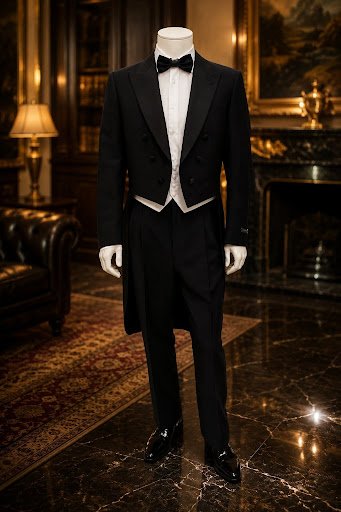

In an era obsessed with casualwear and “quiet luxury,” a surprising number of young men are choosing the most structured garment in the history of Western dress. What is really going on?
There is a photograph making rounds on wedding planning forums that stops most people in their tracks. The groom, no older than 26 by the look of him, stands at the altar in a perfectly cut tailcoat, white waistcoat, and striped trousers. His groomsmen flank him in matching regalia. His bride wears an heirloom veil. The image could easily be mistaken for a sepia-toned portrait from 1895 — except the venue is a repurposed industrial warehouse in East London, the florals are distinctly maximalist, and the date stamp in the metadata reads 2025.
It is an image that raises an obvious and genuinely interesting question: why are young men, the very demographic credited with collapsing the suit industry and normalizing hoodies at funerals, suddenly reaching back past the tuxedo — past the dinner jacket — all the way to one of the most elaborate and historically loaded garments in the Western male wardrobe?
The answer, it turns out, is more nuanced than nostalgia, and considerably more revealing than a mere fashion trend.
To understand the shift, it helps to understand what the tailcoat actually represents. Unlike the tuxedo, which was invented in the 1880s precisely as a more relaxed alternative to the tailcoat for informal evening wear, the tailcoat carries the full weight of ceremony. It is what heads of state wear when meeting monarchs. It is what conductors wear on the podium of the world’s great concert halls. It is what equestrians wear in the dressage ring. Every context in which it appears is defined by ritual, precision, and the deliberate suspension of everyday life.
For much of the late 20th century, that weight was the problem. Formality became associated with stuffiness, with hierarchy, with an older generation’s way of doing things. The tuxedo itself began to feel heavy. The lounge suit crept in as acceptable wedding attire. Then the blazer over open-collar shirt. Then, in certain circles, the statement sneaker beneath the trousers. The trajectory seemed one-directional: perpetually downward.
“They are not putting on a costume. They are making a declaration — this moment is so significant that I am willing to undergo real effort to mark it.”
What appears to be happening now is a counterreaction, and it is coming from an unexpected direction. Gen Z, the generation that grew up watching social media flatten every occasion into casual content, appears to have developed a genuine hunger for the irreducible. For occasions that cannot be photographed casually. For clothing that refuses to be worn ironically.
Menswear historians have a term for this dynamic: the formality pendulum. It operates on a roughly generational cycle. When one generation normalizes informality to the point of ubiquity, the next generation discovers that formality feels transgressive — and therefore interesting. In the early 1990s, men stopped wearing hats because their fathers wore hats. By the late 2000s, young men were fetishizing hat culture. The same dynamic played out with pocket squares, with brogues, with double-breasted suits.
But the tailcoat is different in kind, not just degree. It is not a subtly elevated version of something already familiar. It is an entirely different category of dress, one that carries a specific and non-negotiable set of rules: white tie events, state functions, the most formal evening occasions on the social calendar. Choosing it for a wedding is not merely choosing to dress up. It is choosing to place your wedding in the same ceremonial register as a royal investiture.
That is, of course, precisely the point. Grooms who are opting for the tailcoat in 2026 are not doing so because they found it in a vintage shop and thought it looked cool. They are doing so because they understand exactly what it signals, and that signal is what they want to send. They are not putting on a costume. They are making a declaration: this moment is so significant that I am willing to undergo real effort — real discomfort, real preparation, real learning — to mark it correctly.
There is also an aesthetic argument that has nothing to do with symbolism. The tailcoat, when properly fitted, produces a silhouette that no other garment can replicate. The short front, the sweeping back tails, the high-fastening waistcoat beneath — together they create a vertical line of extraordinary elegance, drawing the eye upward in a way that both the tuxedo and the lounge suit simply cannot achieve. For a generation raised on an unbroken diet of visual media, the purely photographic case for the tailcoat is surprisingly strong. It looks extraordinary. It always has.
What has changed is the context in which it is being appreciated. The internet, for all its sins against formality, has also democratized access to the visual history of elegance. A 24-year-old in Manila or Melbourne can spend an afternoon watching archival footage of Beau Brummell’s descendants, of White Tie dinners at Claridge’s, of Ascot in the 1930s, and arrive at a considered aesthetic opinion about what a man looks like at his best. That opinion is increasingly: tall, structured, and draped in something that took effort.
Formalwear tailors have noticed. Several houses that specialize in morning dress and evening formalwear report a meaningful uptick in younger clientele, many of whom arrive having done serious research. They know the difference between a dress coat and a morning coat. They understand that the mens evening tailcoat is specific to white tie occasions, and they want to know exactly which waistcoat fabric works in which season. They are, in the words of one London tailor, “the most educated first-time customers I have had in thirty years.”
There is one more dimension worth considering, and it is perhaps the most philosophically interesting. Sociologists who study ritual behavior have observed that societies under stress tend to reinvest in ceremony. When daily life feels uncertain, unstable, or simply exhaustingly informal, formal occasions take on heightened significance. The wedding, already the most ritually dense event in most people’s lives, becomes a site where the desire for meaning is especially concentrated.
Choosing to wear a tailcoat to your wedding is, in this reading, not a fashion statement at all. It is a statement about what you believe a wedding is. It is a way of saying, in the most visible language available to a man standing in front of witnesses, that this ceremony matters enough to demand the highest register of dress that Western sartorial tradition has ever produced. That it deserves, in the plainest possible sense, your best.
Whether or not the trend continues — whether the tailcoat becomes genuinely mainstream among younger grooms or remains a beautiful outlier — it has already told us something worth knowing: that Gen Z’s relationship with formality is far more complicated, and far more interesting, than the comfortable narrative of permanent casualization ever suggested. Sometimes the most radical thing a young man can do is show up, impeccably dressed, and mean every stitch of it.