

Walk into a coworking space five years ago and you would have found the same thing everywhere: open-plan floors, communal tables, a espresso machine in the corner, and a vaguely industrial aesthetic. The idea was simple — remove the isolation of working from home and replace it with energy. What no one anticipated was that the noise would become the problem.
In 2026, the most forward-thinking operators have moved past that model entirely. The conversation in coworking design has shifted from aesthetics to functional psychology — and nowhere is that shift more visible than in the rise of dedicated certification and deep-work infrastructure.
From Open-Plan Noise to Intentional Zones
The backlash against open-plan offices has been well documented for years. Research consistently points to ambient noise as a primary killer of focus and cognitive performance. Yet coworking spaces, by their very nature, always struggled to reconcile the social, collaborative energy that attracts members with the silent concentration that deep work demands.
The answer, it turns out, was not to make everywhere quieter. It was to make somewhere quiet. Top-tier spaces in cities from Austin to Amsterdam have begun carving out what operators are calling Intentional Zones — physical areas with a distinct psychological contract attached. You enter knowing what kind of work is expected, and the design reinforces that expectation at every turn.
The Certification Member: A Segment No One Was Designing For
There is a specific type of coworking member that the industry spent years overlooking: the professional who is not just working, but actively upskilling. These are real estate agents preparing for state licensure exams, nurses chasing continuing education credits, IT professionals studying for CompTIA or AWS certifications, and financial analysts grinding through CFA materials in stolen lunch hours.
This segment is enormous. The U.S. Bureau of Labor Statistics estimates that nearly 40% of workers are engaged in some form of structured professional development at any given time. These members are a loyalty opportunity for coworking operators. Someone studying for a 12-week certification course needs consistency, reliability, and a proper environment — not just an occasional hot desk.
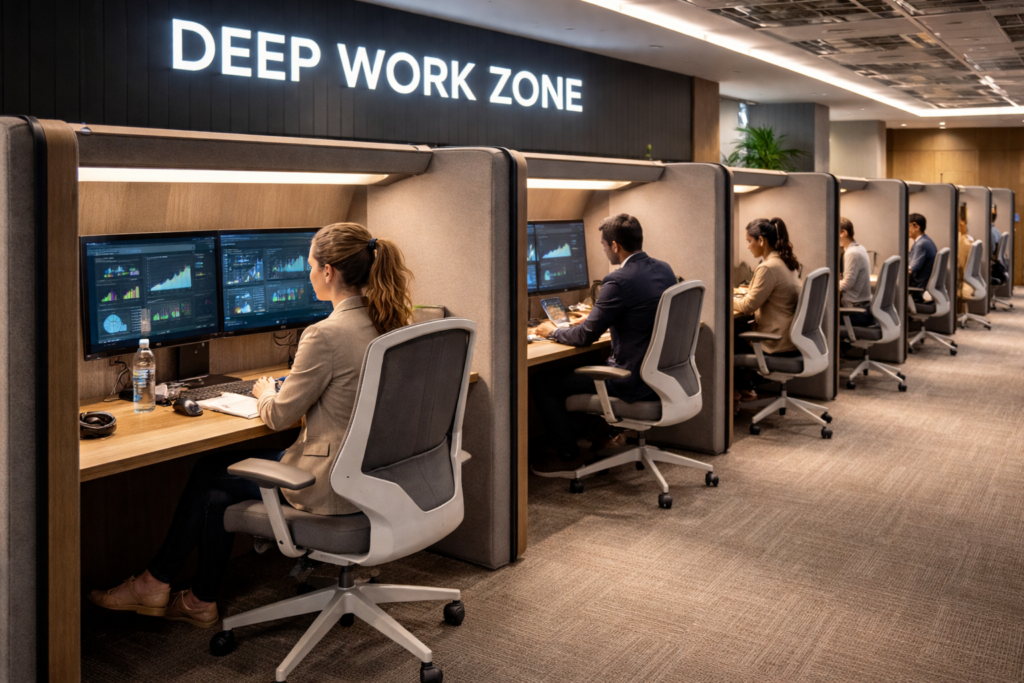
Deep Work Zones: What They Actually Look Like
Modern coworking design in 2026 has moved past aesthetics and into functional psychology. Operators are realizing that a significant portion of their members are not just working — they are upskilling. By creating Deep Work Zones equipped with high-speed, secure terminals, these spaces allow professionals to transition from daily tasks to rigorous study sessions seamlessly. To test their knowledge under realistic conditions, members are increasingly utilizing comprehensive practice tests for professional certification during their afternoon deep-work blocks, ensuring they can verify their competency in the same quiet, professional environment where they actually do their work.
The physical design of these pods is deliberate. Acoustic paneling eliminates ambient distraction. Monitors are positioned to reduce neck strain during three-hour study sessions. Secure, private internet connections mean members can access proctored mock exams or employer-sensitive training platforms without concern. Some operators have even gone as far as installing dedicated exam-simulation software on terminals — mimicking the interface of formal testing environments so that when exam day arrives, the experience feels familiar rather than foreign.
Which Credentials Are Driving Demand?
Three industries dominate the certification activity inside these spaces right now. Technology is the most visible — AWS, Google Cloud, and Microsoft Azure credentials have become near-mandatory for IT professionals, and the study material is dense enough that candidates need focused, distraction-free environments for weeks at a time.
Real estate is a close second. State licensure requirements are stringent, and the exam pass rates for unprepared candidates remain stubbornly low. Candidates preparing for these exams benefit enormously from simulated testing conditions — timed, distraction-free, and structured around the actual format of the Pearson VUE real estate licensing exam. Healthcare rounds out the top three, with nursing boards, medical billing certifications, and allied health credentials all driving sustained study demand.
What This Means for Space Operators
For operators still running undifferentiated open-plan floors, the 2026 market is sending a clear signal. The members who commit longest, spend most consistently, and generate the strongest word-of-mouth are often professionals with structured goals — and those goals require structured environments. The coworking spaces winning in this environment are not necessarily the largest or the best-located. They are the ones that took the time to understand what their members actually do between 9 and 5, and then built for it.
The integration of certification infrastructure is not a niche upgrade. It is, increasingly, a baseline expectation — and the spaces that recognize that early will be the ones writing the next chapter of this industry.