
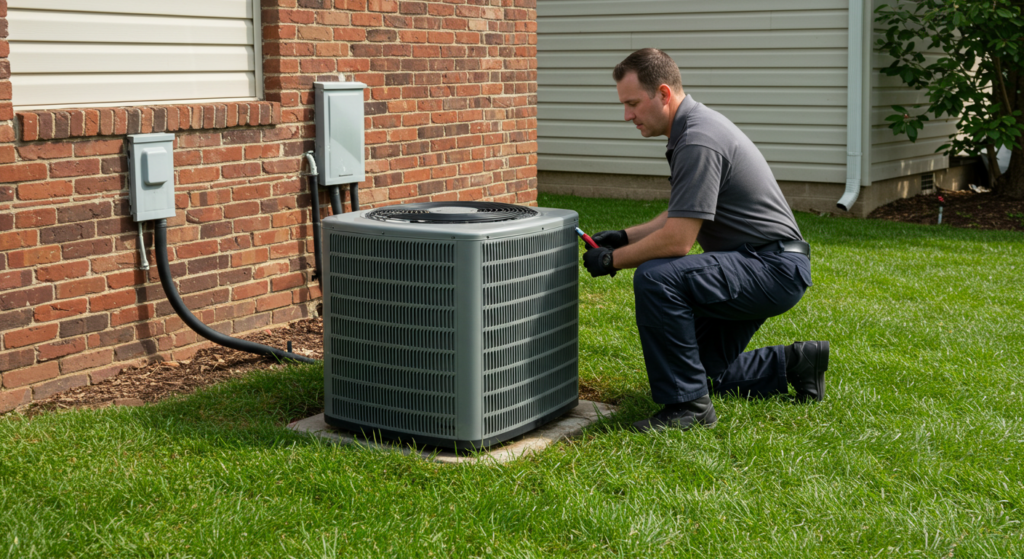

Before recommending a new heating and cooling system, an HVAC contractor usually needs to understand how the home actually performs from room to room. That process is about much more than matching equipment to square footage. A house may have comfort problems caused by insulation gaps, poor airflow, aging ductwork, sun exposure, or window placement, rather than the equipment alone. If those conditions are overlooked, a new system may still struggle to keep temperatures even and energy use under control. That is why a careful evaluation often begins with observation, questions, measurements, and a close look at how the home is built and used every day.
What Contractors Check
- Looking at Size, Layout, and Comfort Patterns
One of the first things an HVAC contractor evaluates is the size and layout of the home, but that step usually goes beyond simply measuring total square footage. The contractor may consider ceiling height, the number of levels, room layout, sun-facing walls, window size, insulation condition, and airflow through different parts of the house. Two homes with the same square footage can need very different system recommendations if one has large west-facing windows, an open floor plan, or a finished upper story that traps heat. Contractors also pay attention to comfort patterns reported by the homeowner. Some homes have one room that stays warm all summer, while others have a lower level that feels cold during winter, even when the thermostat is set correctly. Those details help reveal whether the issue is equipment capacity, airflow imbalance, or the structure itself. The goal at this stage is not just to learn how large the house is, but to understand how the house behaves under real-world conditions and where comfort problems most often occur.
- Checking Existing Equipment and Air Distribution
An HVAC contractor also evaluates the existing equipment and how air is distributed throughout the home. A system recommendation is stronger when it reflects the condition of the current furnace, air conditioner, heat pump, thermostat, vents, returns, and duct network. If the existing system is oversized, undersized, aging, noisy, or running inefficiently, these clues can explain why the home does not feel comfortable, even when the equipment is still running. The contractor may inspect how quickly air reaches different rooms, whether return-air paths are limited, and whether the ducts show signs of leakage, poor design, or restricted airflow. In many cases, the problem is not only the unit itself but also how it works with the rest of the home. A homeowner comparing options after reviewing heating and cooling services by Solutions Heating & Cooling may still benefit most from a recommendation based on airflow testing and system condition rather than brand preference alone. That is because even newer equipment can underperform if the system’s supporting parts are weak or mismatched.
- Reviewing Energy Use, Lifestyle, and Installation Needs
Beyond structure and equipment, contractors often evaluate how the household actually lives in the home. Daily routines can affect which system makes the most sense. A family that spends most of its time upstairs, keeps different schedules, or prefers separate comfort control in certain parts of the home may need a different recommendation than a household with simpler usage patterns. Contractors may also ask about utility costs, humidity concerns, allergy complaints, noise sensitivity, and plans for future remodeling. These details matter because the recommended system should support how the space is used, not just how it looks on paper. Installation conditions are another important part of the evaluation. The contractor may assess available space for indoor and outdoor components, electrical capacity, drainage systems, and access for future service. If a home has limited mechanical space or an older layout, that can affect which systems are practical to install and maintain. By the time this part of the evaluation is complete, the contractor is usually trying to match performance, efficiency, and everyday comfort needs with the physical realities of the house.
A Recommendation Should Fit the Home
A strong HVAC recommendation usually comes after the contractor has studied the home itself rather than rushing straight to equipment options. By considering layout, insulation, airflow, the existing system’s condition, household habits, and installation needs, the contractor can make a recommendation that better fits the space. That approach helps reduce the risk of choosing a system that is too large, too small, or poorly matched to the way the house handles heat and air movement. For homeowners, the real value of the evaluation lies not only in the equipment suggestions at the end. It is the clearer understanding of what the home needs to stay comfortable, efficient, and easier to manage throughout the year.