
Chicago businesses face a familiar challenge: operating costs continue to rise, yet customers still expect reliable service, competitive pricing, and responsible business practices. Electricity is a major expense for many commercial properties, particularly those with large buildings, long operating hours, specialized equipment, or significant heating and cooling needs.
Commercial solar can help businesses take greater control over those costs while supporting long-term financial and environmental goals. Although Chicago is known for cold winters and cloudy days, solar panels can still produce meaningful amounts of electricity throughout the year, making solar a practical option for many offices, warehouses, retail properties, industrial facilities, apartment buildings, and institutional campuses.
Commercial Solar Can Lower Electricity Costs
One of the clearest benefits of commercial solar in Chicago, Illinois, is the opportunity to reduce the amount of electricity a business purchases from the utility. Solar panels generate power during daylight hours, which often overlaps with the busiest part of the workday for many commercial operations.
The exact savings will depend on factors such as roof size, system design, electricity use, shading, utility rates, and the amount of sunlight the property receives. Even when solar does not supply all of a building’s electricity, it can reduce monthly utility costs and create more room in the operating budget.
Those savings may be especially valuable for businesses with thin margins, since every reduction in overhead can support staffing, equipment purchases, marketing, facility improvements, or other priorities that contribute directly to growth.
Greater Energy Cost Predictability Supports Better Planning
Electricity rates can change over time, which makes it difficult for property owners and business managers to forecast long-term expenses. A commercial solar system allows a company to generate part of its own power, reducing its exposure to future utility rate increases.
Predictability matters because businesses rarely make financial decisions one month at a time. Owners may be planning equipment upgrades, lease renewals, expansions, or staffing changes several years in advance, so a more stable energy budget can make those decisions easier.
Commercial solar cannot eliminate every energy-related expense, but it can reduce uncertainty. When a larger portion of electricity comes from an on-site system, the business becomes less dependent on outside pricing changes that it cannot control.
Does Solar Work During Chicago Winters?
Solar panels do not require hot weather to produce electricity. They generate power from sunlight, which means they can continue operating during cold Chicago winters whenever sufficient light reaches the panels.
Shorter days and heavy cloud cover can reduce seasonal production, while snow may temporarily block sunlight if it collects on the system. However, commercial solar systems are designed around annual production, so installers evaluate the entire year rather than judging performance by a few winter days.
Cold temperatures can also support efficient panel operation under the right conditions. Chicago’s climate presents design considerations, including snow loads, wind, roof drainage, and seasonal shading, but those issues can be addressed through proper engineering and installation.
Large Commercial Roofs Offer Valuable Space
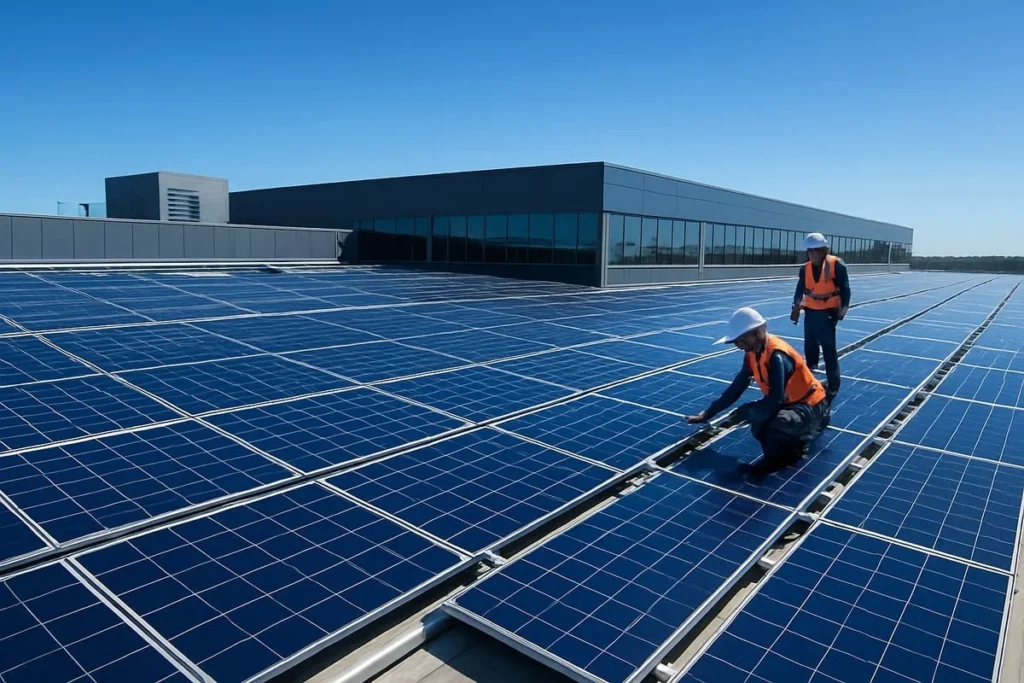
Many Chicago-area commercial buildings have broad, relatively flat roofs that are well suited for solar installations. Warehouses, distribution centers, manufacturing facilities, schools, shopping centers, and office buildings often have substantial unused roof space.
Installing panels on the roof allows the property owner to make productive use of an area that might otherwise provide little direct financial value. The system can generate electricity without taking up parking spaces, landscaping, or interior business areas.
Not every roof is ready for solar, of course. Its age, condition, structural capacity, material, orientation, and access points must all be considered, which is why a professional site assessment should occur before final plans are developed.
Commercial Solar Can Improve a Property’s Long-Term Value
A building with lower operating costs may be more attractive to buyers, investors, and tenants. When a commercial solar system is well designed and properly maintained, it can become a valuable part of the property’s infrastructure.
Potential tenants often compare more than rent alone. They may also examine utility expenses, building efficiency, sustainability features, and whether the space supports their own corporate goals.
Solar does not automatically guarantee a specific increase in property value, because markets, ownership structures, and system agreements differ. Still, a property that offers measurable energy savings may have a stronger position than a similar building with higher ongoing expenses.
Sustainability Can Strengthen a Company’s Reputation
Customers, employees, investors, and community partners increasingly pay attention to how businesses use energy and manage their environmental impact. Commercial solar gives a company a visible way to demonstrate that sustainability is part of its operations rather than just a marketing statement.
A solar installation can support environmental reporting, corporate responsibility programs, procurement requirements, and internal emissions-reduction goals. It may also help a business communicate its values to customers who prefer working with environmentally responsible companies.
The strongest sustainability claims are specific and honest. Instead of relying on vague language, a company can explain how much electricity its system produces, how solar fits into its broader energy strategy, and what additional efficiency measures it is taking.
Solar Supports Environmental Goals
Generating electricity from solar energy can reduce a building’s reliance on power produced from fossil fuels. Over the operating life of a commercial system, that shift may reduce greenhouse gas emissions associated with the property’s electricity use.
Commercial solar can also complement other environmental improvements, including efficient lighting, upgraded insulation, modern heating and cooling equipment, smart controls, and improved energy management.
Solar is often most effective when it is part of a coordinated plan. Reducing unnecessary electricity use before sizing the system may lower project costs and help the available solar power cover a larger percentage of the building’s needs.
Financial Incentives May Reduce Project Costs
Commercial solar projects may qualify for federal, state, local, or utility-related financial programs, depending on the property, system, ownership model, and rules in effect when the project is developed. These opportunities may include tax incentives, depreciation benefits, grants, financing programs, or payments tied to energy production.
Incentives can make a significant difference in the overall economics of a project, but they should be evaluated carefully. Program requirements, deadlines, eligibility rules, and available funding can change, which means businesses should confirm current details with qualified tax, legal, and solar professionals.
A responsible installer should explain which programs may apply without promising benefits that have not been verified. Clear financial modeling should separate confirmed assumptions from estimates, allowing the business to understand both the potential return and the risks.
Is Commercial Solar a Good Long-Term Investment?
Commercial solar systems are generally designed to operate for many years, which allows electricity savings to accumulate over time. Although the initial investment can be substantial, the long service life may help the project deliver value well beyond the original payback period.
The financial return depends on system cost, electricity production, maintenance, financing terms, utility rates, incentives, and the building’s energy use. A detailed proposal should show how these factors affect projected savings rather than relying on broad claims.
Businesses should also consider how long they expect to occupy or own the property. A company planning to remain in the same location for many years may view solar differently from a tenant with a short lease or an owner preparing to sell.
Multiple Financing Options Can Improve Accessibility
Purchasing a commercial solar system outright is one option, but it is not the only path. Depending on the project and market conditions, businesses may consider loans, leases, power purchase agreements, or other financing structures.
Each approach affects ownership, maintenance responsibilities, tax benefits, monthly payments, and long-term savings. A structure with a lower upfront cost may be appealing, although it may also provide less total financial benefit than direct ownership.
Decision-makers should compare total costs over the full agreement rather than focusing only on the first payment. Contract terms, annual price increases, equipment ownership, insurance requirements, and end-of-term options should all be reviewed closely.
Solar Can Support Energy Resilience
A standard grid-connected solar system usually shuts down during a power outage unless it includes equipment designed to operate independently. However, solar can be paired with battery storage and appropriate controls to support certain loads when utility power is unavailable.
For some Chicago businesses, resilience may be just as important as monthly savings. Refrigeration, communications, security systems, lighting, medical equipment, and critical technology may need backup power during an outage.
Battery storage adds cost and complexity, so it should be designed around clear operational priorities. A business may not need to power the entire facility, but it could benefit from keeping essential systems running until normal service returns.
Commercial Solar Can Help Meet Tenant and Corporate Requirements
Large companies often have sustainability standards that affect where they lease space, which suppliers they use, and how they evaluate facilities. A commercial property with solar may be better positioned to meet those expectations.
This advantage can matter for industrial buildings, office campuses, and multi-tenant properties seeking long-term occupants. Solar production data may help tenants document progress toward internal energy or emissions goals.
Property owners should be clear about how benefits are allocated, especially in buildings where tenants pay their own utility bills. Metering, lease terms, shared-area electricity, and system ownership should be addressed before installation.
Solar Carports Offer Another Use for Commercial Property
A business that lacks enough suitable roof space may be able to install solar panels over parking areas. Solar carports generate electricity while also providing shade and some protection from rain and snow.
This option can be useful for shopping centers, corporate campuses, schools, hospitals, dealerships, and other properties with large parking lots. The structures may also support lighting, electric vehicle charging, or visible sustainability branding.
Solar carports typically require more structural work than rooftop systems, so costs may be higher. However, the additional property benefits can make them worth considering when roof limitations prevent a larger installation.
Professional Design Is Essential in Chicago
Chicago’s weather places real demands on commercial buildings. Solar systems must be designed to account for wind, snow, roof conditions, drainage, electrical requirements, and safe maintenance access.
A qualified solar company should complete a detailed site evaluation, analyze the building’s electricity use, and review structural and electrical conditions. The final system should be sized around realistic energy goals rather than simply filling every available section of the roof.
Permitting, utility coordination, inspections, and interconnection requirements must also be managed correctly. An experienced commercial installer can guide the project through these steps while keeping the owner informed.
Maintenance Needs Are Generally Manageable
Commercial solar systems have relatively few moving parts, which can simplify maintenance compared with many other building systems. Regular inspections can help identify loose connections, damaged components, debris, drainage issues, or performance changes.
Monitoring software can show how much electricity the system is producing and help reveal unexpected declines. When a problem appears, early attention may prevent a small issue from affecting a larger portion of the system.
Maintenance responsibilities should be clearly defined before installation, particularly when the system is leased or owned by another company. Building owners should understand who monitors performance, handles repairs, and coordinates roof work.
Solar Should Be Coordinated With Roof Planning
Installing solar on a roof that will need replacement soon can create unnecessary costs, since panels may have to be removed and reinstalled later. Before moving forward, the owner should compare the expected life of the roof with the projected operating life of the solar system.
In some cases, completing roof repairs or replacement at the same time as the solar installation may be the most practical approach. Coordinating the work can reduce disruption and help ensure that warranties remain clear.
Roof contractors, structural engineers, electricians, and solar professionals should communicate throughout the process. Careful planning protects both systems and reduces the risk of disputes if a leak or structural concern develops.
How Should a Chicago Business Evaluate a Solar Proposal?
A strong proposal should include system size, estimated annual production, equipment specifications, installation costs, financing assumptions, warranties, and projected savings. It should also explain how shading, roof conditions, weather, and equipment degradation were included in the calculations.
Businesses should compare more than the total number of panels. Equipment quality, installer experience, workmanship warranties, service capabilities, and financial assumptions can affect long-term performance.
Be cautious when a proposal guarantees savings without explaining the basis for the estimate. Commercial solar can provide meaningful benefits, but credible projections should be supported by clear data and reasonable assumptions.
Commercial Solar Can Become Part of a Broader Business Strategy
The benefits of commercial solar in Chicago, Illinois, extend beyond reducing a utility bill. A well-planned system can support financial stability, property value, environmental goals, energy resilience, and a stronger public reputation.
The best results come from careful planning. Businesses should understand their electricity use, confirm roof and structural conditions, compare financing options, verify available incentives, and work with professionals who have experience with commercial projects.
Chicago may have cold winters, changing weather, and complex building requirements, but those conditions do not prevent businesses from benefiting from solar. With the right design and realistic expectations, commercial solar can become a practical long-term investment that supports both daily operations and future growth.